What does lifting heavy mean for women?
Lifting heavy means choosing a weight that is genuinely challenging for your body for the reps you planned, while your form holds. That is the whole definition. A heavy set for one woman might be a 10 lb dumbbell. For another it is a 135 lb deadlift. Both are lifting heavy if the last rep or two take real effort and still look clean.
It does not mean a one-rep max, grinding through ugly reps, or lifting what the person next to you lifts. It also does not mean light weights for twenty easy reps. In perimenopause, falling estrogen makes muscle and bone harder to keep, and a weight you can lift all day is not enough of a signal to tell them to stay. For the why, see should I be lifting heavy in perimenopause.
Is heavy different for women?
The principle is the same for everyone: heavy is relative to you. What is different is where most women start. Many of us were taught that light weights and high reps are the women's version, and that heavy is for men. So the most common mistake is not lifting too much, it is lifting far too little for years. Average strength charts for women are not a target either. Your weight, your history, and your week matter more than any table.
Over 40 the stakes go up. Falling estrogen speeds up the loss of muscle and bone, and a weight you could lift all day is not enough of a signal to hold onto them.
How much weight should a woman lift to tone?
The same as to get strong. Toned is muscle you can see, kept and slightly built, and muscle responds to challenge, not to endless light reps. Pink dumbbells you can lift twenty times without effort will not get you there. And no, lifting heavy will not make you bulky: building large muscles takes years of deliberate eating and training, and it gets harder as estrogen falls, not easier.
How do I know if I am lifting heavy enough?
Judge it by how the end of the set feels, not by the number on the weight. The simplest tool is reps in reserve: when you finish a set, ask how many more clean reps you could have done.
- 4 or more left: too light. Go up next set.
- 2 or 3 left: a good working weight while you are learning, and on most sets.
- 1 left: heavy. This is where your hardest set of the day should land once you know the movement.
- 0, or your form broke: too heavy for today. Drop the weight and keep the reps clean.
Other signs you are in the right place: the last rep is slower than the first, you need the full rest before the next set, and you could not hold a conversation mid-set. Signs you have gone too far: your back rounds, your knees cave, you hold your breath and strain, or anything hurts in a sharp or joint-deep way. Effort should be in the muscle, never a sharp pain.
What does heavy look like at each level?
In the Phaes method, the reps, sets, and rest change with your level, and heavy changes with them. Fewer reps means a heavier weight for the same effort.
Beginner: 3 sets of 8, twice a week
Rest about 30 seconds between sets. Pick a weight where the eighth rep is hard but clean. If you are new to a movement, spend the first couple of weeks a little lighter while you learn it, then let the weight climb. Heavy for you, not for anyone else.
Intermediate: 5 sets of 5, three times a week
Rest about 2 minutes between sets. With only five reps, the weight should be noticeably heavier than you would use for eight. Try to go a little heavier on the last set. If you only get two or three clean reps on it, that is fine: it means the weight is doing its job.
Advanced: 5 sets of 3, four times a week
Rest about 3 minutes between sets. Lift as heavy as you can while holding form, and aim to finish your last set with about one rep in reserve. This is not a max attempt. It is a heavy, controlled set you could repeat next week.
Core work is different: plank-style holds of 30 to 60 seconds, or sets of 20 building toward 50 for other core exercises. Heavy is for the main lifts.
How do I find my starting weight?
- Warm up with a light set of the movement.
- Pick a weight you think you can lift for your target reps.
- Do one set and count the reps you had left.
- Adjust. Four or more left, go up. Form broke before the target, go down. Two or fewer left with clean form, that is your weight.
- Write it down. Next time, start there.
Most women start lighter than they need to. That is fine for a session or two. The mistake is staying there for months.
When do I go heavier?
When your planned reps start to feel like they have two or more left in the tank on every set, it is time for a small step up: the next dumbbell, or a little more on the bar. Small jumps beat big ones. Getting stronger over months is the goal, not setting a record today.
What about bad weeks?
Heavy is relative to the day, too. Broken sleep, a rough stretch of your cycle, or a stressful week can make a usual weight feel much harder. Keep the effort honest rather than forcing the number. Every fourth week, the Phaes method builds in a reset week: same sets and reps, at about 70% of your usual weights, so your body can absorb the work. See deload weeks for women over 40.
If you have a bone density concern, a heart condition, a recent injury, or pelvic floor symptoms, check with your clinician before you load up. Sharp, lingering, or joint pain is a reason to stop, not to push through. Phaes is informational, not medical advice.
How Phaes helps
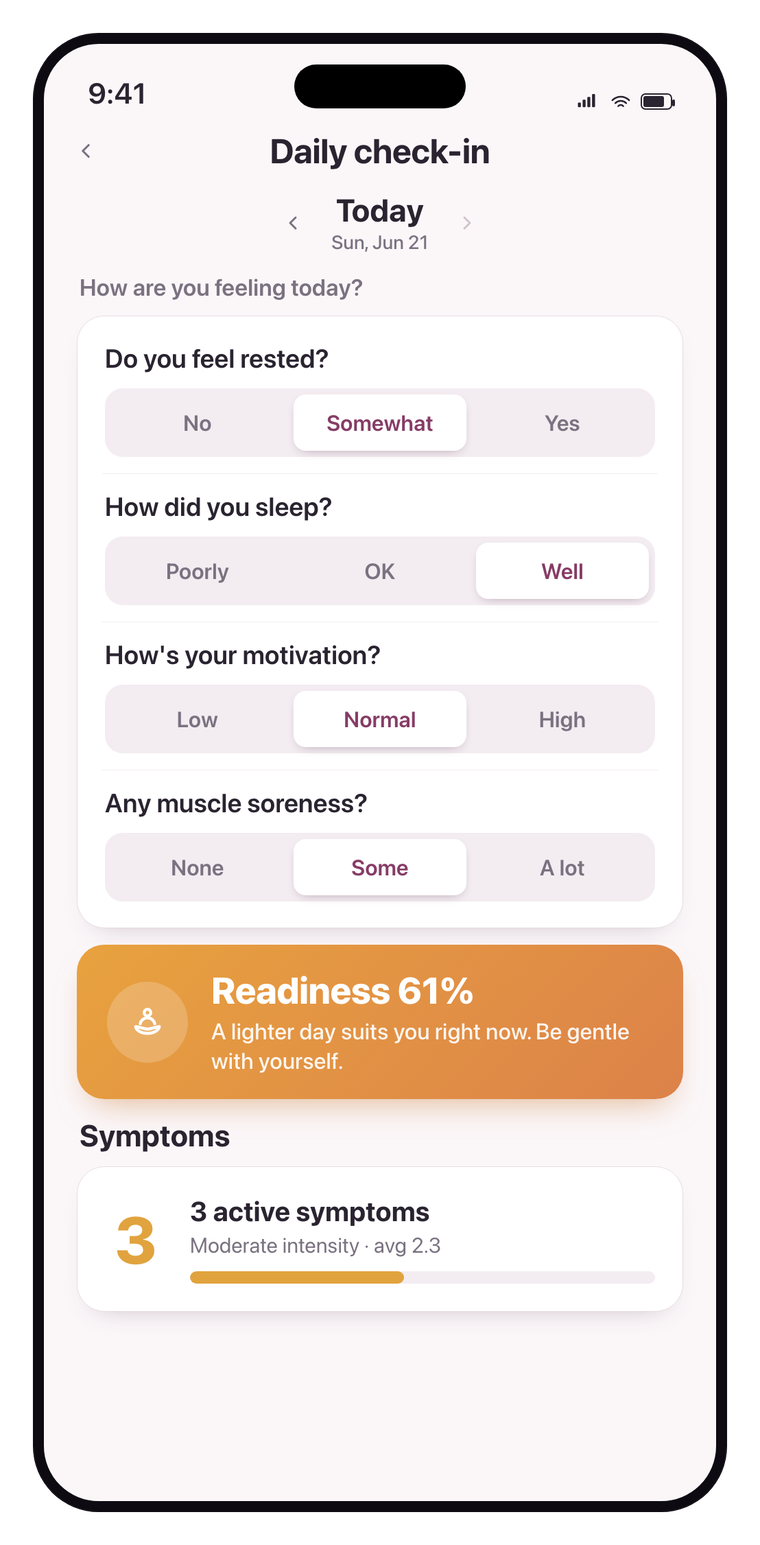
Phaes never tells you a number to lift, because heavy is yours to judge. It gives you the sets, reps, and rest for your level, tells you what the effort should feel like, and logs what you lifted so you can see yourself getting stronger. Reset weeks are scheduled for you, and the plan adapts around how your sleep, cycle, and symptoms are going. See the perimenopause workout plan.
Frequently asked questions
How much weight should a woman lift?
There is no single number. A woman should lift a weight that is genuinely challenging for her for the reps she planned, with good form: the last rep or two should be hard but clean. For a beginner that might be a 10 lb dumbbell, for an experienced lifter a 135 lb deadlift. Both count as lifting heavy.
What does lifting heavy mean for women?
Lifting heavy means using a weight that is genuinely challenging for your body for the reps you planned, with good form. It is about effort, not a number: the last rep or two of a set should be hard but clean. It does not mean a one-rep max or lifting what anyone else lifts.
How do I know if I am lifting heavy enough?
Count your reps in reserve: when the set ends, how many more clean reps could you have done? Four or more means it is too light. Two or three is a good working weight. One left is heavy, which is where your hardest set should land. If your form broke, it was too heavy for today.
How many reps is lifting heavy?
Heavy lifting usually means lower reps with more weight. In the Phaes method, beginners do 3 sets of 8, intermediates 5 sets of 5, and advanced lifters 5 sets of 3. The weight at each level is whatever makes the last rep or two genuinely hard while your form holds.
Is lifting heavy safe over 40?
For most healthy women, yes, when the weight goes up gradually and form comes first. Injuries usually come from jumping in too fast or grinding out ugly reps, not from heavy weight itself. Check with your clinician first if you have a bone, heart, joint, or pelvic floor concern.
Does Phaes tell me what weight to lift?
No. Heavy is personal, so Phaes gives you the sets, reps, rest, and the effort to aim for, and you choose the weight. It logs what you lift so you can see your progress, and it schedules a reset week every fourth week at about 70% of your usual weights.
Keep reading
- Should I be lifting heavy in perimenopause?
- Building muscle in menopause
- Strength training for menopausal women
- Deload weeks for women over 40