Why do I feel like
I'm going crazy?
The rage out of nowhere. The tears. The brain fog. The anxiety that isn't you. The feeling that something is wrong and no one warned you. It's not in your head, and it's not just you. Here's what's happening.
Does any of this sound like you?
Tap everything that feels true. No account, no judgment.
You are not crazy. And you are not alone.
In perimenopause, estrogen and progesterone swing and fall, and both interact directly with the brain chemistry behind mood, focus, and calm. So the rage, the fog, and the anxiety are not character flaws or willpower problems. They are physiological, they are common, and there is a great deal you can do. Phaes treats what you feel as real data, every single day, and turns it into a daily read and a plan built for the body you actually have.
Free to download. Your first week is on us.
Phaes is a coaching app, not medical advice. If your symptoms worry you, please talk to your doctor.
Tap what sounds like you above, and we will show you exactly how Phaes responds. For example:
I snap or rage over tiny things, then feel awful.
Phaes logs your mood as a real signal and adapts your day around it, instead of piling more pressure on a hard one.
I cry at things that never used to touch me.
Your daily check-in captures this, so the plan eases off when you are running on empty.
Anxiety hits out of nowhere, for no reason.
Mood and stress feed your daily read, so a hard day is never forced onto a fragile one.
Why perimenopause messes with your mood
Estrogen does not only run your cycle. It helps regulate serotonin and dopamine, the brain chemicals tied to mood, motivation, and calm. As estrogen and progesterone swing and then fall through perimenopause, that regulation gets noisy. The result can be anxiety that shows up out of nowhere, a shorter fuse, low mood, or a flat lack of motivation, often on top of broken sleep that makes all of it worse.
None of that means something is wrong with you. It means your hormones are in transition and your nervous system is feeling it. You are not imagining it, and you are very much not the only one.
If you were brushed off, you are not imagining it
In a survey by the North American Menopause Society, around 45% of women said their healthcare provider did not take their menopause symptoms seriously. Being dismissed is a documented, systemic problem, not a sign that your symptoms are not real or that you are overreacting.
Perimenopause gets missed for understandable reasons: most clinicians get very little training in menopause, there is no single blood test that confirms it because hormones swing day to day, and the symptoms (anxiety, fatigue, fog, mood) are easy to pin on stress or age. So a lot of women get told "it is just life" when it is their hormones.
How to get taken seriously at your appointment
- Bring a log. Track your cycle and symptoms for 6 to 8 weeks and bring the pattern. It turns "I feel off" into evidence.
- Name it. Say the word perimenopause, and ask directly whether your symptoms fit.
- Ask about options. Including MHT (HRT), and what would rule it in or out for you.
- Find the right clinician. A menopause-informed provider is worth switching for. The Menopause Society has a practitioner finder.
For a full checklist of what to track and ask, see how to prepare for your perimenopause doctor appointment. Advocating for yourself is not the same as going it alone: keep pushing for a clinician who listens, and do not self-prescribe.
Where movement fits
Exercise is one of the most reliable mood levers there is. Regular aerobic running and strength training both improve mood, lower anxiety, and protect sleep. The catch in perimenopause is that the wrong dose backfires. Grinding hard sessions on a depleted, poorly slept, anxious week raises stress hormones and leaves you feeling worse, which is exactly when a rigid plan tells you to push. The goal is to move in a way that steadies you, and to back off before movement turns into another stressor.
How Phaes handles it
Your mood is part of the plan
Phaes asks how you are doing, not just how far you ran. Mood, stress, and sleep are part of a short daily check-in, and they shape the day. On a frayed week the plan leans toward easy aerobic work and steady strength, the kind that calms the system rather than taxing it.
It connects the dots over time
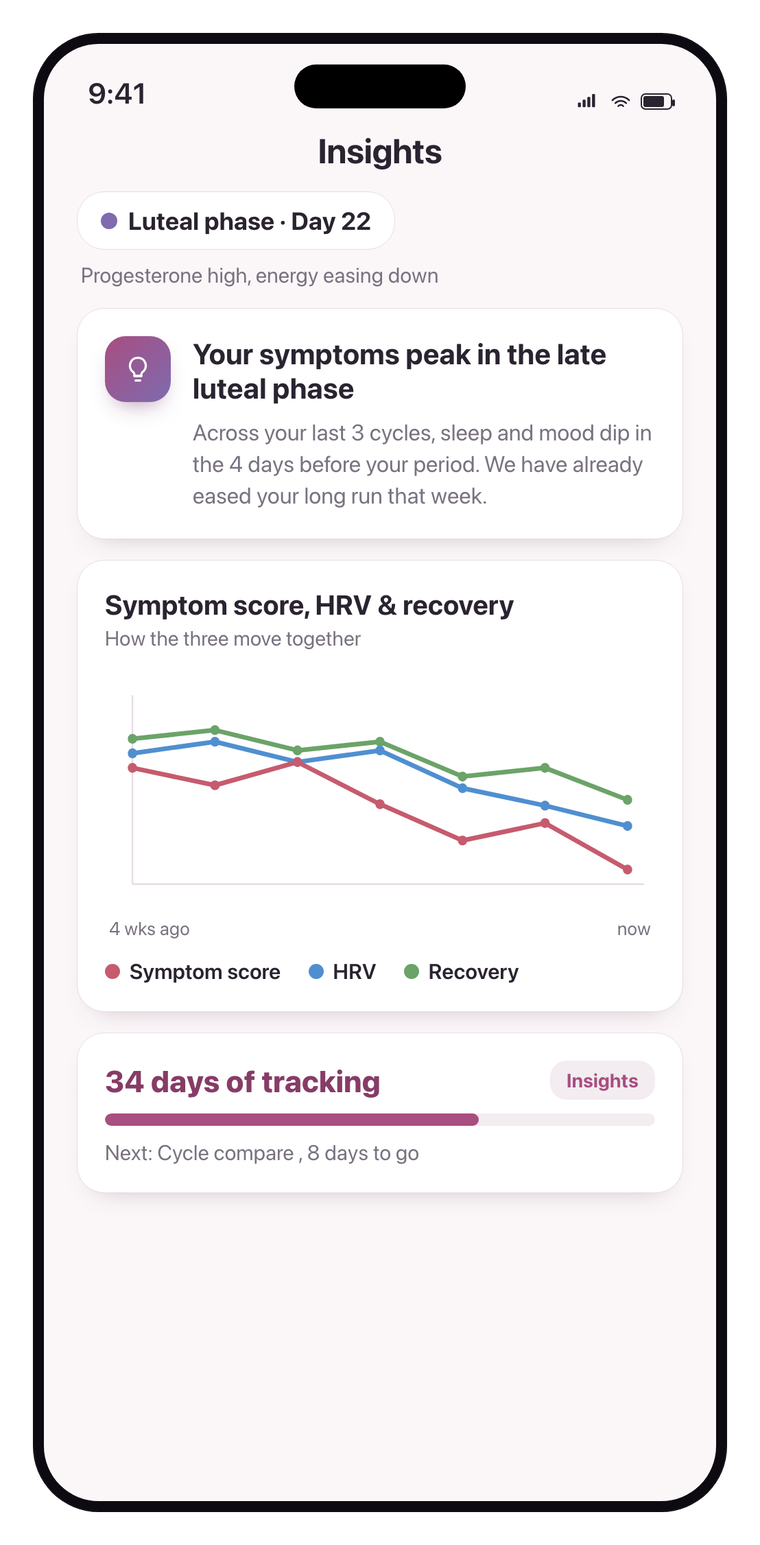
Logging how you feel alongside where you are in your cycle starts to reveal patterns: the days that reliably dip, the weeks that need protecting. It is also the log that makes a doctor listen, turning months of "something is wrong" into a clear picture you can hand across the desk. See how hormone intelligence works.
Phaes is informational, not medical care. If anxiety or low mood is affecting your daily life, please talk to your doctor. What is happening is common and very treatable.
Frequently asked questions
Is anxiety really a symptom of perimenopause?
Yes. Shifting and falling estrogen affects the brain chemicals tied to mood and calm, so anxiety, irritability, and low mood are common in perimenopause, often alongside disrupted sleep. It does not mean something is wrong with you, and it tends to settle as your body moves through the transition.
Why does my doctor say I am too young for perimenopause?
Perimenopause commonly begins in the early-to-mid 40s and sometimes the late 30s, so "too young" is often wrong. Many clinicians have little menopause training. If you feel dismissed, it is reasonable to bring a symptom log or seek a menopause-informed provider.
Is medical gaslighting in menopause a real thing?
Yes. Around 45% of women in a North American Menopause Society survey said their provider did not take their symptoms seriously. It is a documented, systemic gap in care, not a reflection of you or whether your symptoms are real.
Can exercise actually help my mood in perimenopause?
For many women, yes. Regular aerobic running and strength training are well supported for improving mood and sleep and lowering anxiety. The key is dosing it to where you are, since overtraining on a depleted week can make things worse. Phaes adapts the plan to how you feel so movement steadies you instead of draining you.
Should I stop training when I feel terrible?
Usually you do not have to stop, you adjust. Easy aerobic work and gentle strength can help on a rough day, while hard intervals are better saved for when you have recovered. Phaes makes that call for you based on your daily check-in.
Stop wondering if it's
just you. It isn't.
Phaes reads what you feel and turns it into a plan that finally makes sense.
Get startedFree to download. Your first week is on us.
Not ready to download? Get the free guide, straight to your inbox.