
The problem is not your doctor. It is the format.
You get a short appointment. You are asked how you have been feeling. And you are expected to summarise, from memory, six months of sleep, mood, cycle changes, joint pain, brain fog, and everything else, while sitting on the spot. Most people say some version of "tired, I think, and my periods have been weird." That is not enough to act on, and it is not your fault.
Perimenopause is especially badly served by this format. The symptoms are spread across systems that usually get seen by different specialists, they fluctuate rather than progress steadily, and any one of them in isolation looks like something else. The pattern is the diagnosis, and the pattern is exactly what a from-memory summary destroys.
What changes when you bring a record
Specifics are harder to dismiss than adjectives
"I am exhausted" invites reassurance. "I logged poor sleep on 43 of the last 60 days, averaging 3.8 out of 5, clustered in the week before my period" is a clinical finding. Same experience, entirely different conversation.
The clustering is the signal
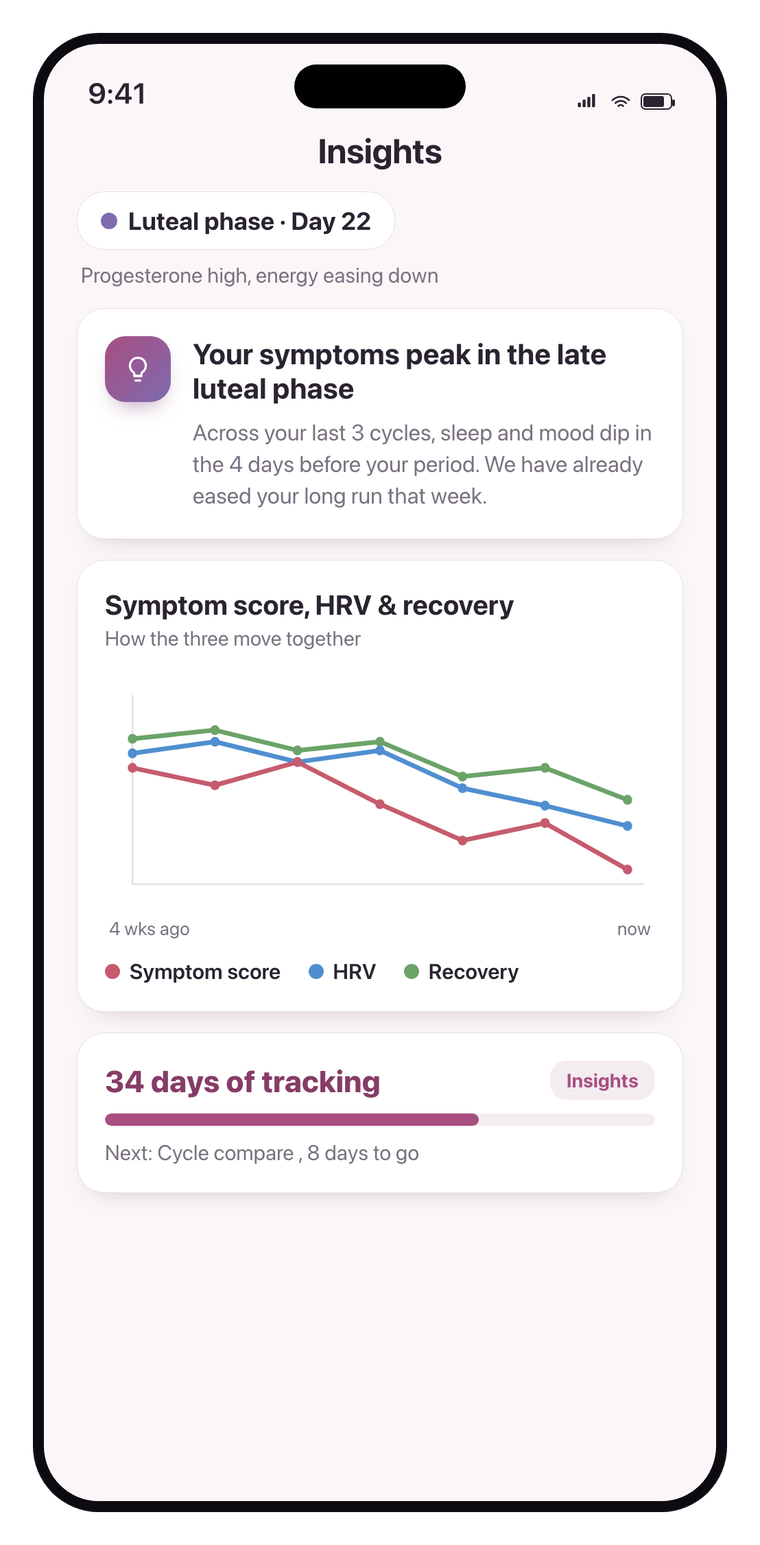
Individually, low mood, disrupted sleep, and joint pain all have a dozen explanations. Seen together, tracked against your cycle, they start to look like one thing. Phaes records symptoms against your actual cycle, so the timing relationship is visible rather than something you have to argue for. See cycle-based training for how the same data drives your plan.
MHT (HRT) gets a real feedback loop
If you are on MHT (HRT), the report carries your regimen, every dose and method change with its date, how consistently you have actually taken it, and how your symptom score moved across the same period. That is the information a prescriber needs to decide whether to adjust, and almost nobody arrives with it. See running and MHT (HRT).
What is in it
- Cycle and life stage: cycle day, recent period dates, average cycle and period length, contraception.
- Symptoms: your most-logged symptoms over the last three months, with how many days each occurred and average severity.
- MHT (HRT): each regimen with dose, method, frequency, start and end dates, adherence, and the full dose-change history.
- Bloodwork: every lab marker you have recorded, with values and dates in order.
- Body composition: weight, muscle mass, body fat, and visceral fat over time.
- Fertility and IVF: your logs, cycles, transfers, and embryo records, if you use them.
Sections you have no data for are omitted entirely, so a runner who has never touched fertility tracking never sees an empty IVF block. You can read it in the app or share it as text, so it can go into an email, a patient portal message, or a note on your phone you read from in the room.
No interpretation, on purpose. The report has no AI summary, no risk score, and no suggested diagnosis. It is your data, formatted clearly, and nothing else. Your clinician does the interpreting, and a report that shows up without opinions attached is a great deal harder to argue with.
How to use it in the appointment
Generate it the day before, not in the waiting room, so you have time to read it and pick your two or three priorities. Lead with the pattern that bothers you most and let the report back it up, rather than reading it out top to bottom. If you leave with a change to your MHT (HRT) or a new prescription, keep logging: the next report will show whether it worked, which is the part of this loop that usually goes missing.
Part of the bigger picture
The report is one output of what Phaes is already doing with your data every day. The same logs drive your daily read and an adaptive training plan built around your symptoms and your cycle. See the perimenopause app, the menopause app, or hormone intelligence for how the engine underneath works.