
Your hormones change how training feels. Most plans ignore that.
Across a cycle, estrogen and progesterone rise and fall, and they change real things: how fast you recover, how a given pace feels, how you handle heat, how you sleep, and how you use fuel. The same tempo run can feel effortless one week and brutal ten days later. A static plan treats every day the same and leaves you feeling like you failed, when the truth is the plan never knew where you were in your cycle.
Cycle-based training fixes that. It is not about doing less. It is about putting the hard work where your body can absorb it, and protecting the days where pushing costs more than it gives. Many people call this cycle syncing: the same idea, applied to your training rather than your diet or your work calendar.
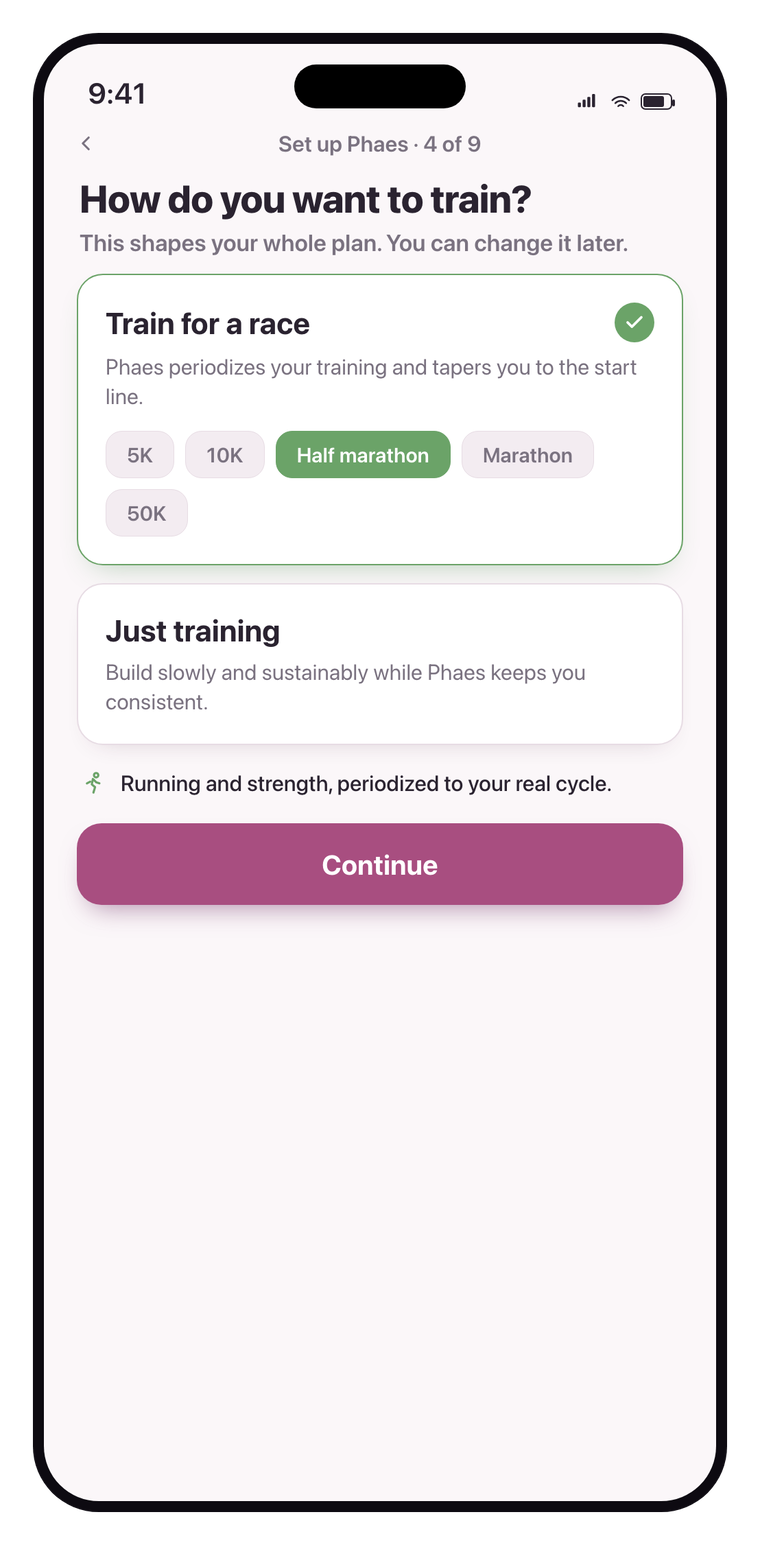
How Phaes builds a cycle-aware plan
It works from your real cycle, not a 28-day myth
Phaes anchors to the cycle starts you log, then projects your phases on demand. When a cycle runs short, long, or skips, the plan does not break. There is no rigid calendar to fall out of sync with, so you are never fighting a plan that assumes a body you do not have this month.
A daily check-in drives the plan
Phase is one signal. How you slept, your energy, soreness, and symptoms are the rest. A short daily check-in feeds straight into your plan, so a rough luteal-phase night does not get treated like a normal one, and a great follicular-phase day is there to use.
Strength is periodized alongside the running
Cycle-based training is not just running. Phaes programs heavy strength work in the same plan (multiple workouts a day, with day-level locking so neither gets dropped), and biases it toward the windows where you build best, so the runner and the body progress together.
Fueling that keeps up with the work
Phaes pairs every plan with a daily nutrition note written for your life stage: iron, protein for the rebuild, carbs for the hard days, and eating enough overall to support the training you are actually doing.
What cycle-based training looks like across the four phases
Bodies vary, so Phaes treats these as starting tendencies and then adapts from your own check-ins and history:
- Menstrual phase. Many runners feel better than expected once bleeding starts. Running on your period is fine for most: train to feel, with iron-aware fueling that week.
- Follicular phase. Rising estrogen often means strong sessions and good recovery. A natural window for quality running and heavier lifting.
- Ovulatory phase. Often a peak for hard efforts, and the phase Phaes is most willing to schedule quality work into.
- Luteal phase. Higher resting effort, more heat, and rockier sleep for some. Luteal phase workouts trend toward more recovery and smarter fueling, without writing the whole phase off.
What Phaes will not do: guess your hormones from a wearable, force an easy day just because a calendar says so, or assume you want to PR every season. Your check-in and your real cycle lead; the phase is context, not a rulebook.
Cycle-based training through every life stage
Cycles change, and eventually stop. The care behind cycle-based training does not. If your cycles are wandering, see running through perimenopause. If they have stopped, the same adaptive, recovery-first coaching carries over in the menopause running plan.
What you get
- A daily workout card matched to your phase and how you feel today.
- Cycle and symptom logging with same-cycle-day history.
- Heavy strength programming periodized alongside your runs.
- Phase-aware nutrition guidance.
- "Change this day" swaps when life gets in the way.
- Heart-rate zones, pace zones, and a goal-race builder.
Phaes is iOS-first and integrates with Apple Health. Cycle and symptom tracking is free. Phaes Insights, your daily read and trends, is $3.99 a month or $29.99 a year, and Phaes Coach adds the adaptive training plan and a coach that adjusts it week to week at $9.99 a month or $69.99 a year. Your first week is free.
Frequently asked questions
What is cycle-based training?
Cycle-based training adjusts your running and strength work to the phase of your menstrual cycle. Estrogen and progesterone shift how you recover, how hard a given effort feels, how you regulate heat, and how you fuel. A cycle-based plan lands hard sessions in windows where you recover well and protects you in phases where the same load lands harder. Phaes builds this automatically from your cycle and a short daily check-in.
Do I have to sync my training to a perfect 28-day cycle?
No. Most cycles are not a textbook 28 days, and plans built on that calendar are wrong almost every month. Phaes anchors to your logged cycle starts and your daily check-in, so when a cycle runs short, long, or irregular, the plan keeps adapting to where your body actually is rather than where a calendar guessed it would be.
Can I do cycle-based training if my cycle is irregular or I am on birth control?
Yes. Phaes is driven first by how you feel day to day, and cycle phase layers on top when it applies. For irregular cycles, hormonal birth control, perimenopause, or no cycle at all, the daily check-in still drives the plan, so training keeps adapting either way.
Is it safe to run hard during my period?
For most runners, yes. Many feel strong once a period starts and estrogen begins to climb. Phaes does not force an easy day just because you are bleeding; it reads your check-in, keeps fueling iron-aware that week, and lets you train hard when you feel up to it.