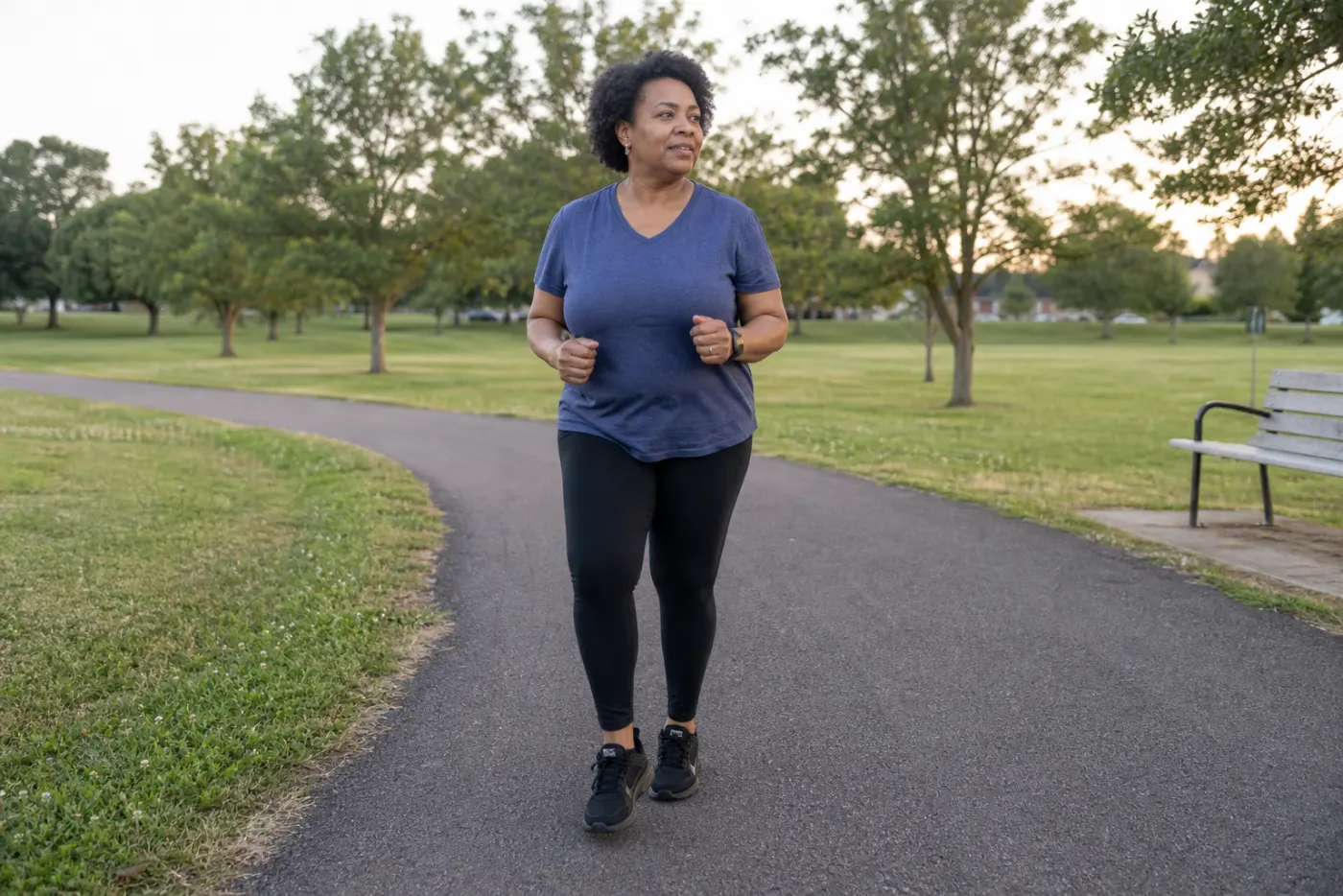
Quick answer: Keep running through winter, but change the setup. Warm up for longer, because cold muscles are weaker and slower. Dress in thin layers you can open or shed, since a hot flash under a heavy jacket leaves you soaked and then chilled. Use the treadmill on icy or dark days without guilt, and move your weekly sprint session indoors to a bike or a steep treadmill incline. New or worsening cold, white fingers are worth a check with your doctor.
By late November the light is gone by five, the pavements are slick, and every run starts with a negotiation between you and the front door. Add a hot flash two miles in, under a jacket you cannot take off, and winter running over 40 can feel like a special kind of punishment. It does not have to. Here is how to set it up so it works.
The short answer: run, but change the setup
Winter does not call for a different plan. It calls for a different setup: a longer warm-up, layers built for hot flashes, a lower bar for using the treadmill, and your sprint session moved indoors when the ground is icy. Keep most runs easy, keep lifting heavy, and protect your rest day and sleep.
The Phaes method stays the same all year. One sprint interval session a week, easy days that are truly easy (a walk, a very easy run, or yoga), heavy lifting by level, one full rest day, and a reset week every fourth week. Winter just changes where and how those sessions happen. If a session moves indoors, it still counts.
Warm up longer when it is cold
Cold muscles are weaker and slower, so a cold start makes the first mile feel awful and hard efforts riskier. Do five minutes of easy movement indoors before you leave, then take the full 10 minutes of very easy running before anything harder. On sprint days, never skip the warm-up to save time.
The physiology is old but clear. In a small classic study by Bergh and Ekblom, 1979 (Acta Physiologica Scandinavica), maximal strength, power, jumping, and sprinting all dropped as muscle temperature fell, by roughly 4 to 6 percent for every degree Celsius. It was only four men, so treat the exact number loosely. The direction is what matters: a cold muscle produces less force.
A simple indoor primer before you go out:
- Leg swings, front to back and side to side, 10 each leg.
- Walking lunges or step-ups on the stairs, 10 each leg.
- Calf raises, 15, because calves and Achilles tendons hate cold starts.
- Marching or skipping on the spot for a minute.
Then run very easy for 10 minutes. If you feel stiff after that, give it 5 more.
Layer for the cold and for hot flashes
Dress in thin layers you can open or remove, not one heavy coat. Hot flashes are triggered by small rises in core temperature, and a run under a sealed jacket supplies exactly that. Start a little cold, vent early, and change out of damp clothes as soon as you stop, before the sweat chills you.
Why layers matter more in perimenopause: research summarized by Freedman, 2005 (American Journal of Medicine) suggests that in women with hot flashes, the band of core temperature the body tolerates may be narrower, so small rises in core temperature can set off a flash. Running warms you fast. Overdressing makes a flash more likely and leaves you wet, then cold.
| Conditions | Base | Over it | Hot flash tweak |
|---|---|---|---|
| Cool, about 40 to 50 F (4 to 10 C) | Long-sleeve wicking top | Light vest or nothing | Tights or shorts, thin gloves you can pocket |
| Cold, about 25 to 40 F (minus 4 to 4 C) | Wicking base layer | Full-zip wind shell | Zip open early, hat off first |
| Very cold, below about 25 F (minus 4 C) | Base plus light mid layer | Wind shell, hat, mittens | Loops near home so you can drop a layer |
These are starting points, not rules. Wind and rain make it feel much colder, and everyone runs at a different temperature. The American College of Sports Medicine position stand on cold injuries (Castellani and colleagues, 2006) recommends choosing clothing for the individual and using the wind chill index, with extra care below about minus 18 F (minus 27 C), where frostbite risk rises. For more on training with flashes, see exercising with hot flashes.
Ice, dark, and the treadmill
On icy or very dark days, the treadmill is a sensible choice, not a cop-out. A fall on ice costs far more training than one indoor run, and bone density declines through menopause, so wrists and hips are worth protecting. Outside, shorten your stride, slow down, wear slip-on traction cleats, and be seen.
The treadmill is closer to outdoor running than its reputation suggests. In a small study of trained runners, Jones and Doust, 1996 (Journal of Sports Sciences) found that a 1 percent incline matched the energy cost of running outdoors at moderate to fast speeds. Set the belt to 1 percent and an easy run is an easy run.
For the dark:
- Run at lunch when you can, and save the treadmill for the evenings.
- Wear a headlamp and something reflective on your moving parts: ankles, wrists, and a vest.
- Pick lit, familiar routes and tell someone where you are going.
- Keep it easy in the dark. Unfamiliar footing is not the place for sprints.
Easy runs in winter should be as easy as the rest of the year. Cold air and layers can push your heart rate around, so go by breathing and feel. Our guide to how easy your easy runs should be covers the talk test.
Your sprint session indoors
The weekly sprint session moves indoors easily. An indoor bike is the simplest option: pedal all-out against firm resistance, then spin very easily. A treadmill works on a steep incline at a hard but controllable speed. Avoid jumping onto a fast belt, and keep the session at least 3 days from any other sprint work.
- Warm-up 10 min very easy spinning Z1
- Main set Up to 10 x (25 s all-out, 1:30 very easy) Z5
- Cool-down 10 min very easy Z1
Everyone starts at 2 x 15 s and adds a little each build week. Beginners top out at 5 x 20 s, advanced at 10 x 30 s.
Beginners use a 5 minute cool-down. Recoveries are a full 1:30, longer if you need it to get your breathing right back down. A dry, clear day is still the best place for sprints, ideally a short hill on good footing. The full guide to sprint interval training covers each level and how the reps build.
Cold hands, chest symptoms, and when to get checked
Cold fingers are normal. Fingers that turn white or blue and then red, go numb, and take a long time to recover may be Raynaud phenomenon. It is common and usually harmless when it starts young, but a first appearance after 40 is worth mentioning to your doctor. So is any chest pain or unusual breathlessness in the cold.
A 2026 American Heart Association scientific statement (Ujueta and colleagues, Circulation) describes two forms. The primary form usually begins in women in their teens or twenties and follows a benign course. The secondary form tends to start later in life and is linked to an underlying condition, and in severe cases can damage the fingertips. That later start is why new symptoms deserve a look.
For everyday cold hands, mittens beat gloves, a pair of thin liner gloves under them helps, and a warm drink before you leave makes a real difference.
Where Phaes fits
Phaes builds your weekly running and strength plan by level, with one sprint session, easy days, a rest day, and a reset week every fourth week. If ice or a dark evening means a run needs to move, “Change this day” shifts the session, and your daily check-in (sleep, stress, symptoms, energy) eases the day when a bad night or a run of hot flashes has left you flat.
The bottom line
Winter running over 40 works when you change the setup, not the plan. Warm up longer, dress in thin layers you can vent, and start slightly cold so a hot flash does not soak you. Use the treadmill on icy or dark days, move sprints to a bike or an incline, and keep easy days easy. New white fingers or chest symptoms in the cold are a reason to see your doctor.
Frequently asked questions
Is it safe to run in the cold over 40?
For most healthy women, yes. The American College of Sports Medicine says exercise can be done safely in most cold conditions with the right clothing and planning, and that people with asthma or heart disease can exercise in the cold with closer monitoring. Watch the wind chill, cover skin when it is very cold, and talk to your doctor first if you have a heart or lung condition.
How should I dress for a winter run with hot flashes?
Use thin layers rather than one heavy coat: a wicking base layer, a light mid layer or vest, and a wind shell with a full zip. Add a hat and gloves you can pull off and tuck in a pocket. Start slightly cold, run loops near home so you can drop a layer, and change out of damp clothes straight after.
Is a treadmill run as good as running outside?
For training purposes, close enough. A small study of trained runners found that a 1 percent incline matched the energy cost of running outdoors at moderate to fast speeds. Easy runs on a treadmill count as easy runs. Keep at least some outdoor running each week if you can, because uneven ground and real downhills train your legs in ways a belt does not.
Can I do sprint intervals on a treadmill?
You can, but changing belt speed takes several seconds, which eats into a 15 to 30 second sprint, and jumping onto a fast belt is risky. An indoor bike is the simplest swap: all-out on the pedals, then easy spinning. On a treadmill, use a steep incline at a hard speed you can control rather than chasing top speed.
Why do my fingers go white in the cold?
That is often Raynaud phenomenon, where small blood vessels in the fingers or toes spasm in the cold or under stress. The common, primary form usually starts young and is harmless. If it starts for the first time after 40, or comes with sores, joint pain, rashes, or skin changes, see your doctor, because it can be linked to another condition.
Should I run less in winter?
Not necessarily. Winter is a good time to keep running mostly easy, lift heavy, and hold one sprint session a week. If ice, dark, or holidays cut a run, swap it for a walk or a treadmill session rather than skipping the week. A rest day and a reset week every fourth week matter more than winter mileage.