Quick answer: Travel in perimenopause goes better with a plan for heat, sleep and medication. Dress in layers and skip alcohol and hot drinks on the plane to limit hot flashes. Shift to local time fast, using morning daylight and exercise to help your body clock. Pack MHT (HRT) in your carry-on with spares, and ask your pharmacist or prescriber how to time doses across time zones. Keep training short: one sprint session, a couple of lifts, and walks.
A long flight, a time change, a hot hotel room, and a suitcase full of things you forgot to pack. Travel was never restful, but in perimenopause it can feel like a symptom stress test. Whether you are flying home for the holidays or heading somewhere warm, here is how to handle the heat, the sleep, the medication, and your training on the road.
The short answer: plan for heat, sleep, and medication
Travel in perimenopause goes better with a plan for three things. For heat, dress in layers and limit alcohol and hot drinks on the plane. For sleep, switch to local time quickly, using daylight and exercise to help. For medication, pack MHT (HRT) in your carry-on with spares and ask how to time doses across time zones.
Training is the fourth piece, and the easiest to overthink. On the road, keep it short: one sprint session, one or two lifts if you can find weights, and walks on the other days. That holds what you have built without turning the trip into a training camp.
Hot flashes on planes and in hotels
Planes and hotels stack common hot flash triggers: warm cabins, crowded seats, alcohol, hot drinks, and stress at the gate. You cannot control the cabin, but you can control layers, drinks, and how easily you can move. A plan of thin layers, water, and a seat you can leave helps more than any gadget.
The NHS lists lightweight clothing, a cool room, a fan, and avoiding triggers such as spicy food, caffeine, hot drinks, and alcohol among the things that can help. All of them are easy to do on a travel day.
| Travel problem | Why it is worse in perimenopause | What to try |
|---|---|---|
| Warm cabin | Small rises in heat can tip a hot flash | Thin layers, air vent, a small fan |
| Drinks trolley | Alcohol and hot drinks are common triggers | Water, cold drinks, skip the wine |
| Hot hotel room | Heat at night brings on night sweats | Turn the heating down, cool shower, light bedding |
| Long security lines | Stress can bring on a flash | Leave early, sit down where you can |
| Late dinners | Big, late meals and drinks cost sleep | Eat earlier when you can, keep drinks low |
For how heat and hot flashes affect your sessions, see our page on exercising with hot flashes.
Jet lag and sleep
Jet lag is your body clock out of step with local time, and it usually settles within a few days. Perimenopausal sleep is already fragile, so it can feel worse. The fastest fix is to live on local time straight away: morning light, meals and sleep at local times, and no daytime sleep if you can help it.
Your internal clock adjusts gradually, and flying east, which shortens your day, is usually harder than flying west, as Sack, 2010 (New England Journal of Medicine) sets out in a clinical review. The NHS advice on jet lag is practical: drink water, avoid too much caffeine and alcohol in flight, get outside in daylight after you land, and avoid sleeping during the day.
Light is the strongest signal for resetting your body clock, according to a review for traveling athletes by Forbes-Robertson and colleagues, 2012 (Sports Medicine). Exercise helps too. In a lab study by Youngstedt and colleagues, 2019 (Journal of Physiology), 99 fit adults, about half aged 59 to 75, did an hour of moderate exercise at different times. Exercise at 7am or in the early afternoon shifted the clock earlier, and exercise in the evening from 7pm to 10pm shifted it later.
In practice, that suggests:
- Flying east: a morning walk or run in daylight on the first days. Keep late evenings quiet.
- Flying west: get outside in the late afternoon and stay up until a sensible local bedtime. An evening walk can help.
- Keep the room cool. Night sweats are more likely in a warm hotel room. Turn the heating down before you go to dinner.
- Go easy on drinks for the first nights. Alcohol breaks up the second half of the night, which jet lag already does.
Melatonin is popular for jet lag, but the NHS does not recommend it for jet lag because the evidence is weak. If you want to try it, ask your doctor first, especially if you take other medicines.
Packing and timing MHT (HRT)
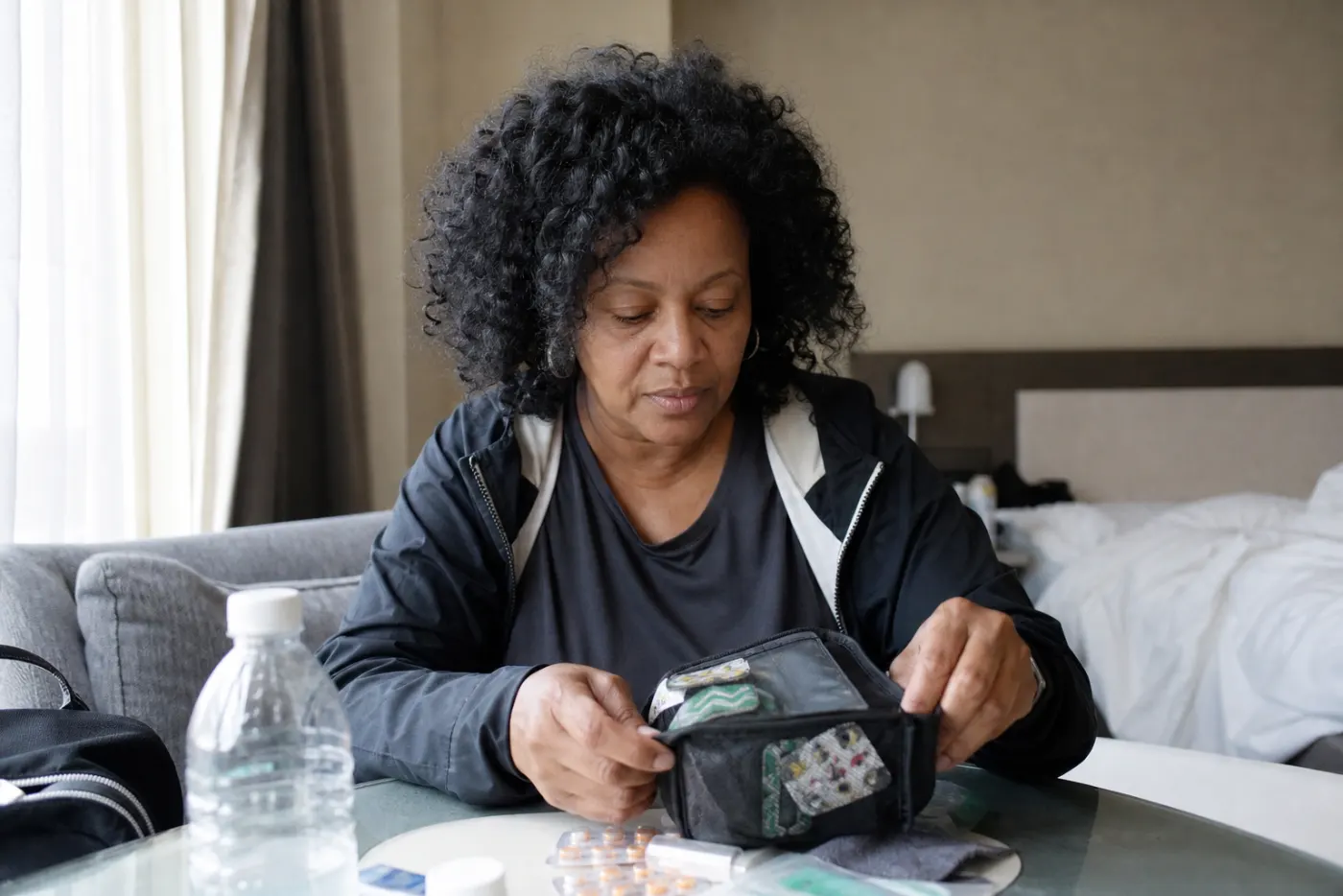
MHT (HRT) needs a little planning on the road. Pack it in your carry-on, in its original packaging, with enough for the whole trip plus a few spare days. Bring a copy of your prescription. Then ask your pharmacist or prescriber how to time doses across time zones, because the answer depends on what you take.
A checklist by type:
- Patches. Pack spares. Heat, sweat, pools, and hot tubs can loosen a patch, and replacements are hard to find abroad. Our guide to exercising with a patch or gel covers keeping one stuck on.
- Gels and sprays. In the US, TSA allows medically necessary liquids and gels in reasonable quantities above the usual limit, as long as you declare them at the checkpoint. Other countries have their own rules, so check before you fly.
- Pills and progesterone. Keep them with you, not in a checked bag. A phone alarm set to your home routine helps until you have a plan for the new time zone.
- Timing across time zones. Ask your pharmacist or prescriber before the trip. Do not guess, double up, or skip doses on your own.
For a refresher on the different forms, see our page on types of MHT (HRT).
Long flights and blood clots
Long journeys of four hours or more raise the risk of a deep vein thrombosis (DVT), a clot in a leg vein. Taking MHT (HRT) is also on the list of risk factors. Most women on MHT (HRT) fly without problems, but it is worth moving around, drinking water, and asking your prescriber whether you need any extra precautions.
The NHS lists taking MHT (HRT) among the things that make a DVT more likely, along with being over 60, smoking, and a past clot. For journeys over four hours, it advises loose clothing, plenty of water, avoiding alcohol, and walking around when you can.
The form of estrogen may matter. In the ESTHER case-control study by Canonico and colleagues, 2007 (Circulation), oral estrogen was linked to about four times the odds of a blood clot, while estrogen through the skin was not linked to higher risk. It was an observational study in French women aged 45 to 70, so it shows an association rather than proof, but it is one reason prescribers consider patches and gels for some women.
Training on the road
On a trip, aim to hold what you have, not to build. One sprint session, one or two heavy lifts if you can find a gym, and walks on most other days is a good travel week. Keep the sprint session at least 3 days from any other, skip it the day after a red-eye, and treat sightseeing on foot as your easy days.
What works where:
- Sprint session: a hill, a park, a beach, or a hotel bike. Keep to the number of sprints you were already doing, with 1:30 easy between; the full sprint interval guide covers every level.
- HIIT in a hotel room: 10 to 20 minutes depending on your level, mostly 40 seconds on and 20 seconds off, with squat jumps, skips, and single-leg hops. Our guide to HIIT for women over 40 has the moves.
- Strength: a gym or day pass for at least one heavy session. Without one, single-leg moves, slow reps, and a loaded backpack keep the habit, but they are lighter than your usual lifts.
- Rest: keep one full rest day a week, and make a travel day count as one if you need it to.
If a trip lands near the end of a training block, shift your reset week to cover it: no intensity, weights about 30 percent lighter, and sleep first.
Where Phaes fits
Phaes builds your weekly running and strength plan and adapts each day’s session from a daily check-in that covers sleep, stress, symptoms, energy, and alcohol, so a jet-lagged morning gets an easier session. “Change this day” moves a workout around travel. Free MHT (HRT) tracking gives you one-tap logging, which helps you keep track of doses across a trip.
The bottom line
Travel in perimenopause needs a plan for heat, sleep, and medication. Dress in layers and skip alcohol and hot drinks in flight. Switch to local time fast with daylight and well-timed exercise. Pack MHT (HRT) in your carry-on with spares, ask your pharmacist or prescriber about timing across time zones, and move around on long flights. Keep training short and portable.
Frequently asked questions
How do I handle hot flashes on a plane?
Wear thin layers you can strip down to, choose a seat where you can get up easily, and use the air vent and a small fan if you have one. Drink water and go easy on alcohol, hot drinks and caffeine, which are common triggers. A cool wipe on the wrists and neck helps some women ride one out.
Can I take MHT (HRT) gel or spray in my carry-on?
In the US, TSA allows medically necessary liquids, gels and aerosols in reasonable quantities for your trip, above the usual liquids limit, if you declare them at the checkpoint. Keep them in the original packaging with your prescription label, and check the rules for your departure and destination countries.
How do I take MHT (HRT) when I change time zones?
Ask your pharmacist or prescriber before you go. How to shift timing depends on what you take, whether a daily pill, a gel, a twice-weekly patch, or progesterone, and how far you are traveling. They can give you a simple plan so you neither miss a dose nor double up.
Does MHT (HRT) raise the risk of blood clots on long flights?
The NHS lists MHT (HRT) among the things that make a deep vein thrombosis more likely, alongside age, smoking and long journeys. Research suggests oral estrogen carries more clot risk than patches or gels. If you have a long-haul flight, ask your prescriber whether you need any extra precautions, and move around regularly in flight.
Why is my sleep so bad when I travel in perimenopause?
Jet lag, a strange room, a warm hotel, late meals and more alcohol all hit sleep at once, and perimenopausal sleep is already fragile. Night sweats are more likely in a hot room. Keep the room cool, get outside in morning light, and keep drinks low for the first few nights.
How do I keep training while traveling?
Keep it short and portable. A sprint session works on a hotel bike, a hill or a park. A 10 to 20 minute HIIT circuit of jumps and hops fits in a hotel room. Bodyweight moves keep the habit but are lighter than gym lifting, so find a gym or day pass for at least one heavy session.