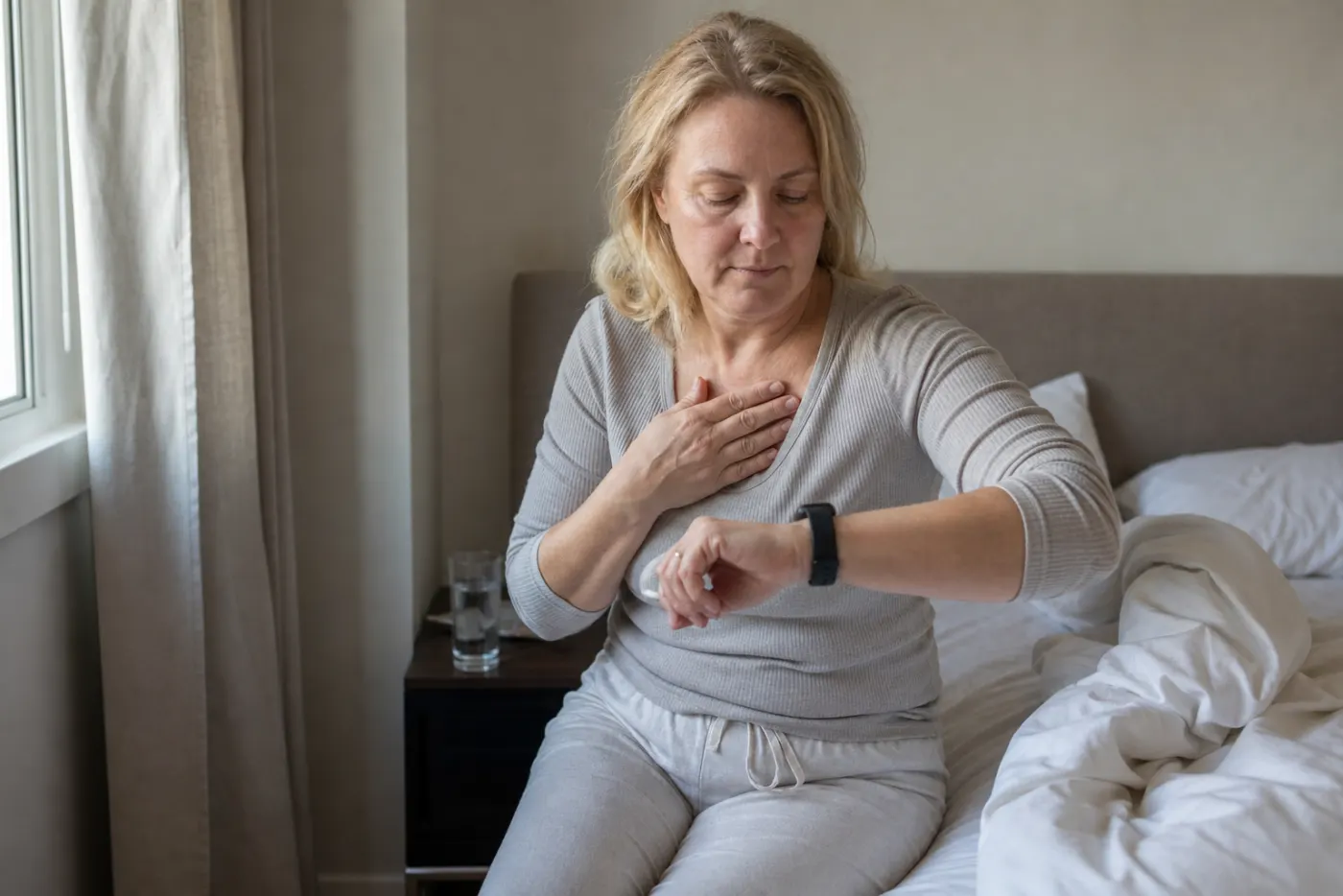
Quick answer: Resting heart rate typically rises a few beats after ovulation and stays higher until your period, when progesterone falls. In perimenopause, broken sleep, night sweats, heat, alcohol, stress, and illness push it up too. A rise of a few beats on one morning means little. A rise well above your usual range for two or more days, with poor sleep or heavy legs, is a good reason to swap hard training for easy.
Your resting heart rate is one of the simplest signals your watch gives you, and one of the easiest to misread. It moves with your cycle, with sleep, with heat, and with stress, and in perimenopause it moves more. This guide explains what drives it, how to read a higher morning number, and what to change in your training that day.
What resting heart rate tells you
Resting heart rate is how many times your heart beats per minute when you are fully at rest, usually measured overnight or just after waking. It reflects fitness over months, but day to day it mostly reflects load: sleep, heat, hydration, alcohol, stress, illness, and hormones. That makes it a useful early warning, as long as you read it against your own baseline.
For adults, the typical resting range is about 60 to 100 beats per minute, and regular exercisers often sit lower. Your number on its own says little. What matters is change: a morning that is clearly above your usual range, especially two or three mornings in a row, alongside other signs that you are not recovered.
Measure it the same way every day. Overnight readings from a watch or ring are the most consistent. If you measure manually, do it lying down before you get up, not after coffee and a dash to the bathroom.
How your cycle moves it
If you still have cycles, resting heart rate tends to rise a few beats after ovulation and stay higher through the luteal phase, then fall when your period starts. Progesterone raises core temperature slightly, and heart rate follows. The change is small, a few beats, and it varies between women.
The clearest data comes from a 2017 study by Shilaih and colleagues (Scientific Reports). Ninety-one women wore wrist sensors during sleep across 274 ovulatory cycles. Pulse rate was about 2.1 beats per minute higher in the fertile window than during the period, and about 3.8 beats higher in the mid-luteal phase.
The women in that study were 22 to 42 and ovulating regularly. In perimenopause, cycles without ovulation have little progesterone rise, so the luteal bump can disappear some months. Heart rate variability shows the mirror image of this pattern; see HRV and your menstrual cycle.
What else pushes it up in perimenopause
In perimenopause, the biggest drivers of a high morning heart rate are often not the cycle at all. Night sweats and broken sleep, hot flashes, a warm bedroom, alcohol the night before, dehydration, stress, and an infection coming on can each add more beats than the luteal phase does.
| Driver | Typical effect on resting heart rate | What to do |
|---|---|---|
| Luteal phase | A few beats higher | Train as planned if you feel fine |
| Broken sleep or night sweats | Often higher the next morning | Swap hard sessions for easy |
| Alcohol the night before | Often higher overnight | Easy day, hydrate |
| Heat or a warm bedroom | Higher | Cool the room; easy if you slept badly |
| Illness coming on | Can rise a day or two before symptoms | Easy or full rest |
| Hard training the day before | Slightly higher | Normal; easy day next |
Our guide to heart rate zones in perimenopause explains why the same factors also push your exercise heart rate higher, so easy runs feel harder on those days.
What a rise means for training today
Read a high morning heart rate together with how you slept and how you feel. A few beats up with good sleep and fresh legs: train as planned. Clearly above your usual range for two or more days, or with poor sleep and heavy legs: swap any hard session for an easy one. With fever or symptoms below the neck: rest.
A rule of thumb many coaches use is to pay attention when your morning heart rate sits more than about 5 beats above your usual average for more than a day. It is a rule of thumb, not a threshold from research, so adjust it to your own data. A practical decision guide:
- Sprint day, heart rate up a little, feeling good: warm up for 10 minutes and decide. If the warm-up feels normal, do your sprint intervals.
- Sprint day, heart rate clearly up, feeling flat: swap for an easy run, walk, or yoga. Do not move the sprints to tomorrow if that breaks the 3-day spacing.
- Strength day: lift as planned or a set lighter. Strength is less sensitive to a single high morning than sprinting.
- Several high mornings plus poor sleep: a few days with no intensity and lighter weights, like a short reset week.
Resting heart rate or HRV?
Both are useful, and neither is a verdict on its own. Resting heart rate is simple, consistent across devices, and easy to understand. HRV reacts more sharply to sleep, stress, and illness, but it is noisier. Watching both, as weekly trends against your own baseline, gives a clearer picture than either number by itself.
In a review of heart rate monitoring in sport, Buchheit, 2014 (Frontiers in Physiology) concluded that resting heart rate and HRV are most informative when tracked as trends over days and weeks, read alongside training load and how the athlete feels, rather than as single daily values. That advice fits perimenopause well, where any one night can be thrown off by a hot flash.
When a high heart rate needs a doctor
Most morning rises have an everyday cause. But a resting heart rate that stays high for weeks, or a racing heart with chest pain, fainting, dizziness, or breathlessness, needs medical attention. Palpitations are common in perimenopause and often harmless, but new ones should still be checked rather than trained around.
Thyroid problems, anemia, and some medicines can raise resting heart rate, and they are common in midlife women. The NHS guidance on heart palpitations lists when to get urgent help. Our page on heart palpitations in perimenopause covers the hormone link and when to seek help.
Where Phaes fits
Phaes does not plan your training from a daily resting heart rate number. It reads your cycle if you have one, your symptoms, and your daily check-in, including how you slept and how you feel, and adjusts the plan from those. On a rough day it swaps the hard session for an easy one, so a noisy reading never has to make the call alone.
The bottom line
Resting heart rate rises a few beats in the luteal phase and climbs with poor sleep, night sweats, heat, alcohol, stress, and illness. Read it against your own baseline, alongside sleep and how you feel. A small rise is no reason to change the plan; several high mornings with poor sleep mean easy days, and a persistently high rate or new symptoms mean a doctor.
Frequently asked questions
Does resting heart rate change during the menstrual cycle?
Yes. In a study of 91 women using wrist sensors during sleep, pulse rate was about 2 beats per minute higher in the fertile window than during the period, and nearly 4 beats higher in the mid-luteal phase. It falls again when your period starts. The pattern varies between women.
Why is my resting heart rate higher in perimenopause?
Usually because of what perimenopause does to sleep and temperature. Night sweats, broken sleep, hot flashes, and stress all raise resting heart rate the next morning. Some women also notice palpitations. A persistently high resting heart rate, or one that comes with symptoms, should be checked by a doctor.
Should I train if my resting heart rate is high?
If it is a few beats up and you feel fine, train as planned. If it is clearly above your usual range for two or more days, or you feel flat, swap hard sessions for easy ones. If it comes with a fever, chest pain, dizziness, or breathlessness, do not train, and seek medical advice.
What is a normal resting heart rate for a woman over 40?
For adults, a normal resting heart rate is generally 60 to 100 beats per minute, and regular exercisers often sit lower. What matters for training is your own baseline. Track it for a few weeks and watch for changes from your usual range, rather than comparing with others.
Can a high resting heart rate mean I am getting sick?
Often, yes. A rise in resting heart rate frequently shows up a day or two before you feel the symptoms of a cold or other infection. If your morning heart rate jumps and you feel run down, take the day easy. Rest fully if you have a fever or symptoms below the neck.