Quick answer: A home strength workout works when it stays heavy. Keep your level's scheme (3 sets of 8 twice a week for beginners, 5x5 three times for intermediate, 5x3 four times for advanced), do no more than 3 exercises plus one core exercise per session, and pick home variations hard enough that the last reps are a real effort. Single-leg moves, slow lowering, and pauses make dumbbells, a kettlebell, or bands work harder than they look.
Some weeks the gym is not happening. The in-laws are in the spare room, the roads are icy, the January membership queue is out the door, or you simply want to lift in the kitchen while the potatoes boil. A home strength workout can carry you through, as long as it stays heavy. Here is how to build one at your level with the kit you have.
The short answer: same scheme, harder exercises
At home, keep the sets and reps your level calls for and change the exercise, not the dose. If 8 reps of a two-legged squat with your heaviest dumbbell feel easy, switch to a split squat, slow the lowering, or add a pause. Do no more than 3 exercises plus one core exercise per session, and keep the full rest between sets.
The Phaes method, written by coach Kristina Folcik, says lift heavy: heavy is whatever genuinely challenges your body. Home training only fails when it quietly turns into light circuits with short rests, which feel busy but do little for strength. Keep each set hard, keep the rests, and rotate through body parts so each session stays short.
Can you lift heavy enough at home?
Often, yes, if you make the exercises harder as the weights stay the same. Research suggests muscle can grow with lighter loads when sets end close to failure, while maximal strength responds best to heavy loads. Bands can match weights for strength gains. Bone is the exception: it seems to need heavier loading than most home kits allow.
The evidence, briefly:
- Load and muscle. A meta-analysis by Schoenfeld and colleagues, 2017 (Journal of Strength and Conditioning Research) pooled 21 studies with all sets taken to failure. Muscle growth was similar with light and heavy loads, but one-rep max strength improved more with heavy loads.
- How close to failure. A 2024 series of meta-regressions by Robinson and colleagues (Sports Medicine) found muscle growth increased as sets ended closer to failure, while strength gains were similar across a wide range. The authors note the reps in reserve were estimated, not measured.
- Bands. A 2019 meta-analysis by Lopes and colleagues (SAGE Open Medicine) found no difference in strength gains between elastic bands and conventional weights. It included only eight studies, in mixed populations.
- Bone. In the LIFTMOR trial (Watson and colleagues, 2018, Journal of Bone and Mineral Research), 101 postmenopausal women with low bone mass, average age 65, did supervised 5x5 sets at over 85 percent of their maximum twice a week. Spine bone density rose 2.9 percent, against a 1.2 percent fall with a low-intensity home program.
So: at home, chase hard sets. For bone, add impact work (see plyometrics for bone density) and get under heavy weights in a gym when you can.
Your scheme, by level
Your level sets the sets, reps, sessions, and rest, at home or in a gym. Beginners do 3 sets of 8 twice a week with 30 seconds of rest. Intermediate lifters do 5 sets of 5 three times a week with 2 minutes. Advanced lifters do 5 sets of 3 four times a week with 3 minutes. Every session ends with one core exercise.
Lift heavy at home, by level
- 2 sessions a week
- 30 s rest between sets
- Last 2 reps of each set should be hard
- 3 sessions a week
- 2 min rest between sets
- Add weight on the last set; finishing only 2 reps is fine
- 4 sessions a week
- 3 min rest between sets
- As heavy as form allows, 1 rep in reserve on the last set
Core is plank-type holds for 2 sets of 30 to 60 seconds, or other core moves for 2 sets of 20, working up to 2 sets of 50. If you are new to lifting or coming back after a long break, start at beginner. Every fourth week is a reset week: same sets and reps with weights about 30 percent lighter.
The home rotation: 3 exercises plus core
Each session trains up to three body parts, one exercise each, plus core. The body parts rotate across sessions, so a full rotation can take more than a week. Beginners rotate five days at two a week, intermediate lifters four days at three a week, and advanced lifters four days at four a week.
The rotations, each day finished with core:
- Beginner: chest, back, shoulders. Then glutes, hamstrings, quads. Then biceps and triceps. Then hips, adductors, abductors. Then lower back and calves.
- Intermediate: biceps, triceps, calves. Then chest, back, shoulders. Then glutes, hamstrings, quads. Then hips, adductors, abductors.
- Advanced: biceps, triceps, calves. Then quads, hamstrings, adductors. Then chest, back, shoulders. Then glutes, lower back, hips.
Pick one home exercise per body part:
| Body part | With dumbbells or a kettlebell | With bands or bodyweight |
|---|---|---|
| Chest | Floor press | Push-up, feet raised as it gets easy |
| Back | One-arm row, braced on a chair | Band row from a door anchor |
| Shoulders | Half-kneeling overhead press | Band overhead press |
| Biceps | Curl | Band curl |
| Triceps | Overhead extension | Close-grip push-up |
| Glutes | Single-leg hip thrust off the sofa, weight on the hip | Banded glute bridge with a squeeze |
| Hamstrings | Single-leg Romanian deadlift | Towel slider leg curl |
| Quads | Bulgarian split squat | Split squat, 3 second lowering |
| Hips | Cossack squat or curtsy lunge | Lateral lunge or clamshell |
| Adductors | Sumo goblet squat | Copenhagen plank, knee supported |
| Abductors | Side-lying leg raise with a band | Band lateral walk |
| Lower back | Kettlebell or dumbbell good morning | Floor back extension |
| Calves | Single-leg calf raise on a step, holding a weight | Single-leg calf raise on a step |
| Core | Weighted dead bug | Plank or side plank |
One session, written out
A beginner’s glutes, hamstrings, and quads day takes about 25 minutes with one or two dumbbells and the sofa. Warm up with a few easy sets, then do three sets of eight on each side for each exercise, resting 30 seconds between sets. Finish with core. If eight reps are easy, slow down or add weight next time.
- Warm-up 5 min easy movement, then a light set of each exercise
- Main set Single-leg hip thrust, single-leg Romanian deadlift, Bulgarian split squat: 3x8 each side, 30 s rest. Then dead bug 2x20.
- Cool-down 5 min easy walk and gentle mobility
The last 2 reps of each set should be hard. If they are not, make the exercise harder next session.
Intermediate and advanced lifters use the same structure with their own scheme and longer rests. On a 5x5 day, the fifth set is the heavier one, and on a 5x3 day the last set stops one rep short of failure.
How to make light weights heavy
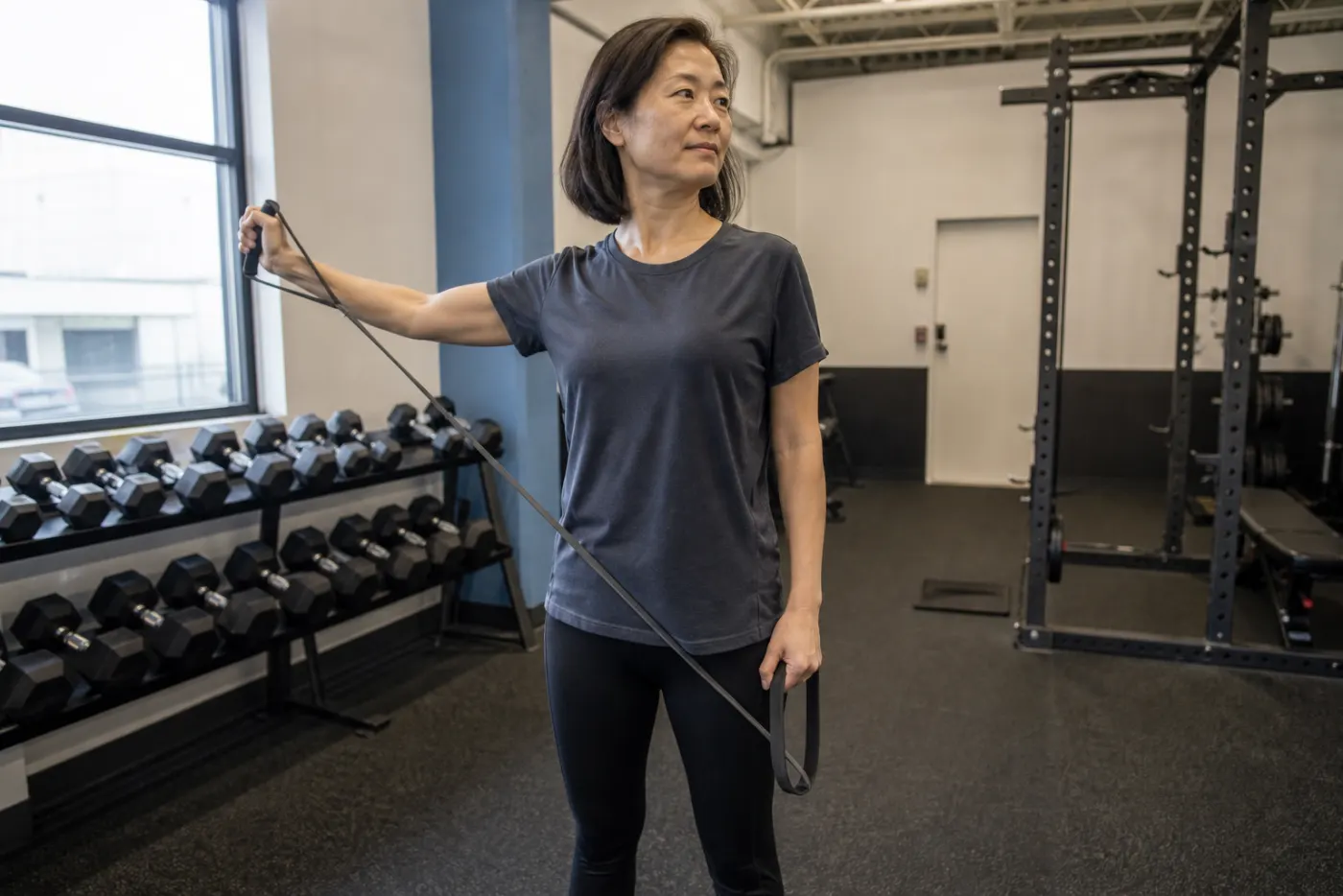
When your heaviest weight stops feeling heavy, change the lever before you change the plan. Go single-leg or single-arm, slow the lowering phase to three or four seconds, add a two second pause at the hardest point, or use a band over the dumbbell. Each makes the same weight harder without adding reps.
In order of what to try first:
- One side at a time. A Bulgarian split squat with two dumbbells is far harder than a goblet squat with the same weight.
- Slow the way down. Three or four seconds lowering, then a normal speed up.
- Pause at the bottom. Two seconds in the hardest position, no bouncing.
- Increase the range. Push-ups with hands on books, split squats with the front foot on a step.
- Stack resistance. Stand on a band and hold a dumbbell in the same hand.
Keep the rests at your level’s length. Cutting them turns a strength session into a sweaty circuit, which is a different and less useful workout for strength. If you already do the weekly HIIT circuit, it needs no equipment at all, so home training covers your whole week.
When home is not enough
Home training holds strength and can build it, but heavy 5x5 and 5x3 lower-body work usually needs more load than most home kits have. If the hardest variation of an exercise still feels light at 5 reps, buy a heavier kettlebell, or keep your big lower-body days for the gym and do upper body and hips at home.
That split works well in practice. Arms, shoulders, chest, back, and hip work are easy to load at home with dumbbells and bands. Glutes, quads, and hamstrings at five or three heavy reps are where a barbell or heavy dumbbells earn their place. Protein matters as much as the kit: the protein calculator gives a daily target for women who lift.
Where Phaes fits
Phaes builds your strength days by level with the method above, 3 exercises plus core per session, and picks exercises for the equipment you tell it you have: a full gym, home dumbbells, bands, or none. It runs a reset week every fourth week at about 70 percent of your usual weights, and your daily check-in eases the day after a short night.
The bottom line
A home strength workout works when it stays heavy. Keep your level’s sets, reps, and rests, do no more than 3 exercises plus core, and rotate body parts across sessions. When the weights stop feeling heavy, go single-leg, slow down, or pause before adding reps. For heavy lower-body work and bone, get to a gym when you can, and treat home days as real training, not a stopgap.
Frequently asked questions
Can you build muscle at home with light weights?
Yes, within limits. A 2017 meta-analysis found muscle growth was similar with light and heavy loads when sets were taken close to failure, while gains in maximal strength were greater with heavy loads. So light weights can build muscle if the sets are genuinely hard, but they are a weaker tool for strength and probably for bone.
What equipment do I need for a home strength workout?
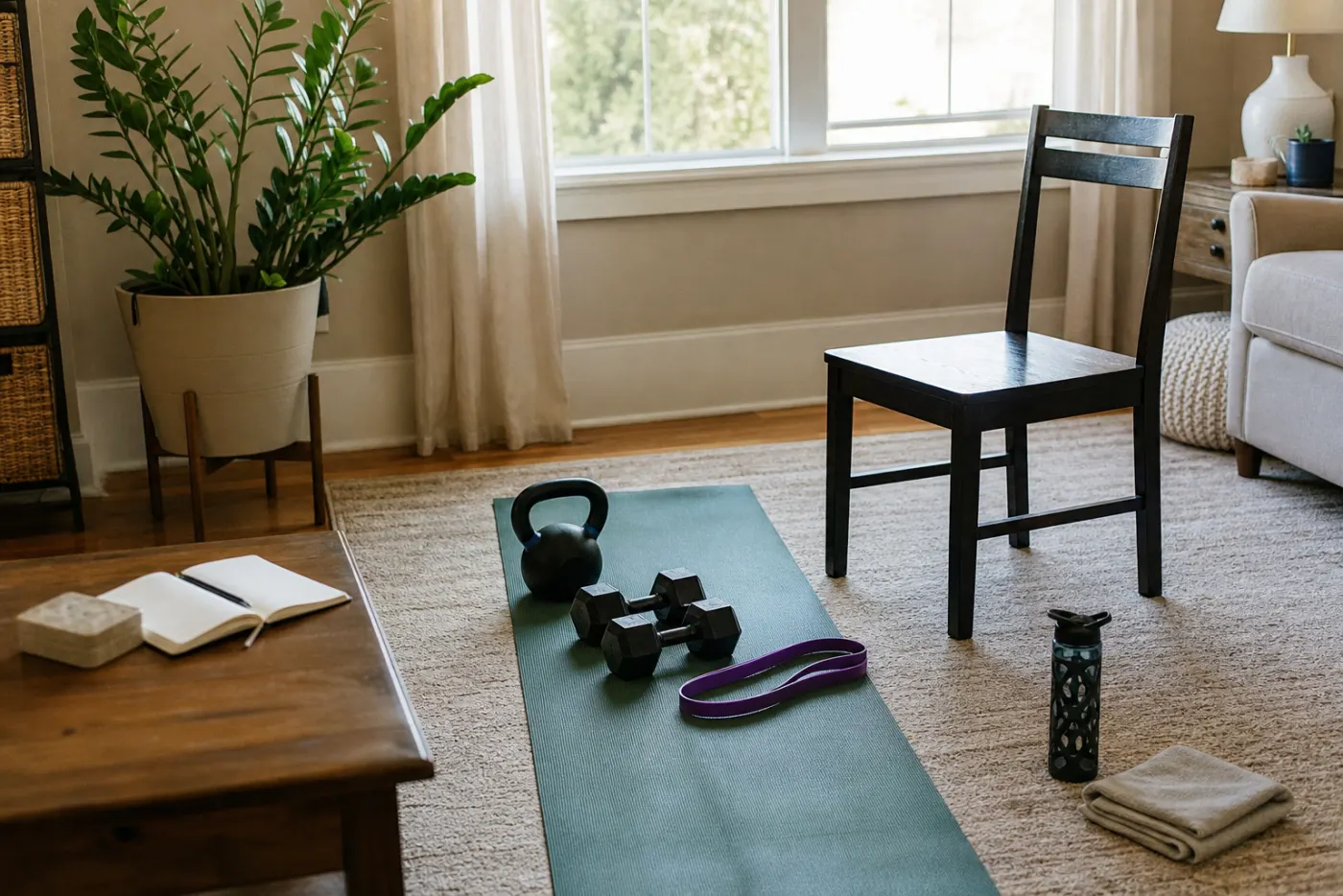
A few pairs of dumbbells or one or two kettlebells, a set of resistance bands with a door anchor, a sturdy step or bench, and a mat cover almost everything. Adjustable dumbbells save space. If you can buy only one thing, choose a kettlebell or dumbbell heavy enough that 8 goblet squats with good form are genuinely hard.
Are resistance bands as good as weights?
For strength in general, bands can do a similar job. A 2019 meta-analysis of eight studies found no difference in strength gains between elastic bands and conventional weights. The catch is load: light bands run out quickly for big lower-body muscles, so pair them with single-leg moves or a heavier band as you progress.
How long should a home strength session take?
About 20 to 45 minutes, depending on level. A beginner session of three exercises at 3x8 with 30 seconds of rest takes around 20 minutes plus core. Intermediate and advanced sessions take longer because the rests are 2 and 3 minutes, which is why the method caps each session at three exercises plus core.
Is a home workout enough for bone density?
It helps, but heavy loading matters most for bone. The LIFTMOR trial in postmenopausal women with low bone mass used supervised sets of five at over 85 percent of maximum. Most home kits cannot load the spine and hips that heavily, so add impact work such as jumps and get to a gym for heavy lower-body lifts when you can.
Should I do the same home workout every time?
No. Rotate through body-part days so each session has at most three exercises plus core, and every body part gets worked across the rotation. Keep the exercises the same for a few weeks so you can see progress, then make them harder by adding weight, a slower lowering phase, or a single-leg version.