
What exercise actually builds bone in menopause?
Two kinds: heavy resistance training and weight-bearing or impact exercise. Bone responds to meaningful load, so lifting challenging weights and moving your body against gravity (walking briskly, jogging, hopping, stair climbing) signal bone to hold on and rebuild. According to the NHS, weight-bearing and muscle-strengthening exercise both support bone health. Gentle, non-loading movement does not deliver the same stimulus.
This matters most now because estrogen, which helps protect bone, declines through the menopause transition. As The Menopause Society notes, bone loss accelerates around the final period and the years right after it. That is exactly why these years are a critical window: what you do with load and impact now shapes the bone you carry into later life.
Why is walking alone not enough?
Walking is genuinely good for you: it is weight-bearing, it helps your heart, your mood, and your blood sugar, and it is the easiest habit to keep. But walking on its own is a fairly low load for bone, and bone adapts to the size of the challenge you give it. To meaningfully build and protect bone in menopause, you need heavier resistance and some higher-impact movement layered on top of your steps, not steps alone.
This is also why swimming and cycling, as wonderful as they are for fitness, do little for bone. They are largely non-weight-bearing: the water or the bike carries you, so your skeleton never has to fight gravity or absorb impact. Keep them for joy and cardio, but do not count on them to defend your bone density. For that, you need to load.
How heavy does the strength work need to be?
Heavy enough to genuinely challenge you, which means more than light toning. A practical target for most movements is a weight you can lift for roughly six to eight clean reps where the last rep or two are hard but your form holds. If you can rattle off twenty easy reps, it is too light to stress bone. The load should climb slowly over months as you adapt, because that progressive challenge is the whole point.
- Compound lifts first. Squats, hinges (like deadlifts), presses, rows, and loaded carries train the most muscle and load the most bone for your time.
- Real load, lower reps. Think sets of about six to eight challenging reps, not endless circuits.
- Load the spine and hips. These are the sites that fracture most often after menopause, so movements that load them sensibly matter most.
- Progress, do not just repeat. Add a little weight or a rep when last week felt solid; bone responds to the climb, not the routine.
What about impact and balance work?
Impact builds bone, and balance keeps you from the falls that turn weak bone into a fracture. Short bursts of higher-impact movement (a set of hops, skips, a little jogging, or jumping if your joints are happy) load bone in a way steady walking cannot. You do not need much: brief, regular doses of impact are enough to send the signal, as long as you build up gradually rather than leaping in cold.
Balance and lower-body strength are the other half of the equation. Most fractures after menopause happen because someone falls, so training single-leg stability, ankle and hip strength, and quick reactions is protective in its own right. Strong, steady, and well-loaded beats fragile and cautious. A body that does not fall rarely needs to test how strong its bones really are.
What if I already have osteopenia or osteoporosis?
Exercise still matters, often more, but the details should be guided by a clinician first. A diagnosis of osteopenia or osteoporosis does not mean you should stop loading; in fact, appropriate resistance and weight-bearing work remains one of the most useful things you can do. What changes is the need for individual screening, because certain movements (heavy spinal flexion, high-impact jumping, twisting under load) may need to be modified depending on your bone density and fracture risk.
So if you have been told your bones are thinning, get cleared and ideally get a tailored starting point from your doctor or a physiotherapist before you load heavy or add impact. Then build from there. The aim is to train with confidence inside safe limits, not to avoid exercise out of fear, which for most people makes the situation worse, not better.
Exercise is one of the best-evidenced ways to protect bone in menopause, but this page is informational, not medical advice. If you have osteopenia, osteoporosis, a past fragility fracture, or any bone, joint, or heart concern, clear your plan with your clinician before you lift heavy or add impact, and ask for guidance tailored to you.
How do I start and progress safely?
Start with the movement, not the weight. Spend the first few weeks learning to squat, hinge, press, row, and carry with light load and clean form, then add weight in small steps as each pattern feels controlled. Two to three strength sessions a week, plus brief regular impact once you are moving well, is plenty to drive change. The goal is a slow, steady climb you can sustain for years.
- Weeks 1 to 3: learn the patterns with light weight, full range, and control; keep impact gentle.
- Then: add load whenever last week's sets felt solid, in small jumps, and layer in short doses of impact.
- Always: warm up, leave a rep in reserve, and treat sharp or lingering pain as a stop sign, not something to push through.
ACOG and the NHS both encourage strength and weight-bearing exercise for women at this stage, so this is a green light to load, not a reason to tread carefully forever. The early caution is about learning the movements, not about your bones being too fragile to train.
Should my cycle change how I train for bone?
If you are still cycling, even irregularly, it can help to read your week. Many women feel strongest in the first half of the cycle and more fatigued or symptomatic in the days before a period, when a heavy session lands harder. The bone-building work does not have to happen at identical intensity every week. Loading hardest when you can absorb it, and easing back when symptoms spike, keeps you progressing without grinding yourself down.
In perimenopause the cycle gets unpredictable, so this becomes less about a fixed calendar and more about responding to how a given week actually feels. That is the part most generic bone-health programs ignore entirely.
How Phaes helps
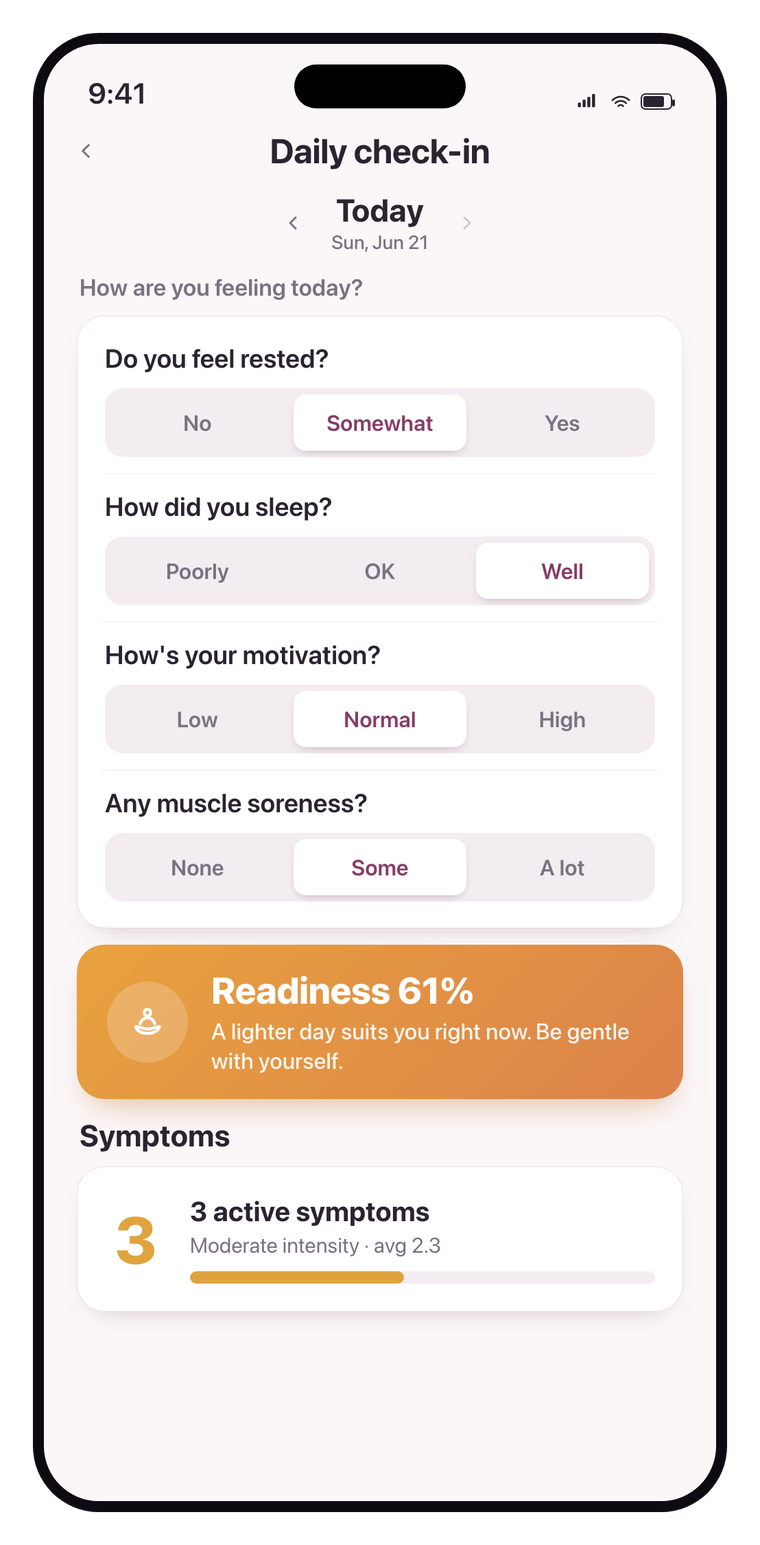
Phaes does not just track your cycle, it programs the heavy, progressive strength that protects bone. It builds your sessions around real compound lifts (squats, hinges, presses, rows, carries) with load that climbs over time, layers in weight-bearing and impact work where it belongs, and waves the intensity with your cycle and symptoms: heavier work in the weeks you can absorb it, a deload when symptoms spike. A short daily check-in and a load guard keep your lifting and any running from stacking into injury, which matters even more when bone is the goal.
If you want the bigger picture, see strength training for menopausal women, learn more about lifting weights in perimenopause, or read building muscle in menopause. You can also explore the perimenopause app.