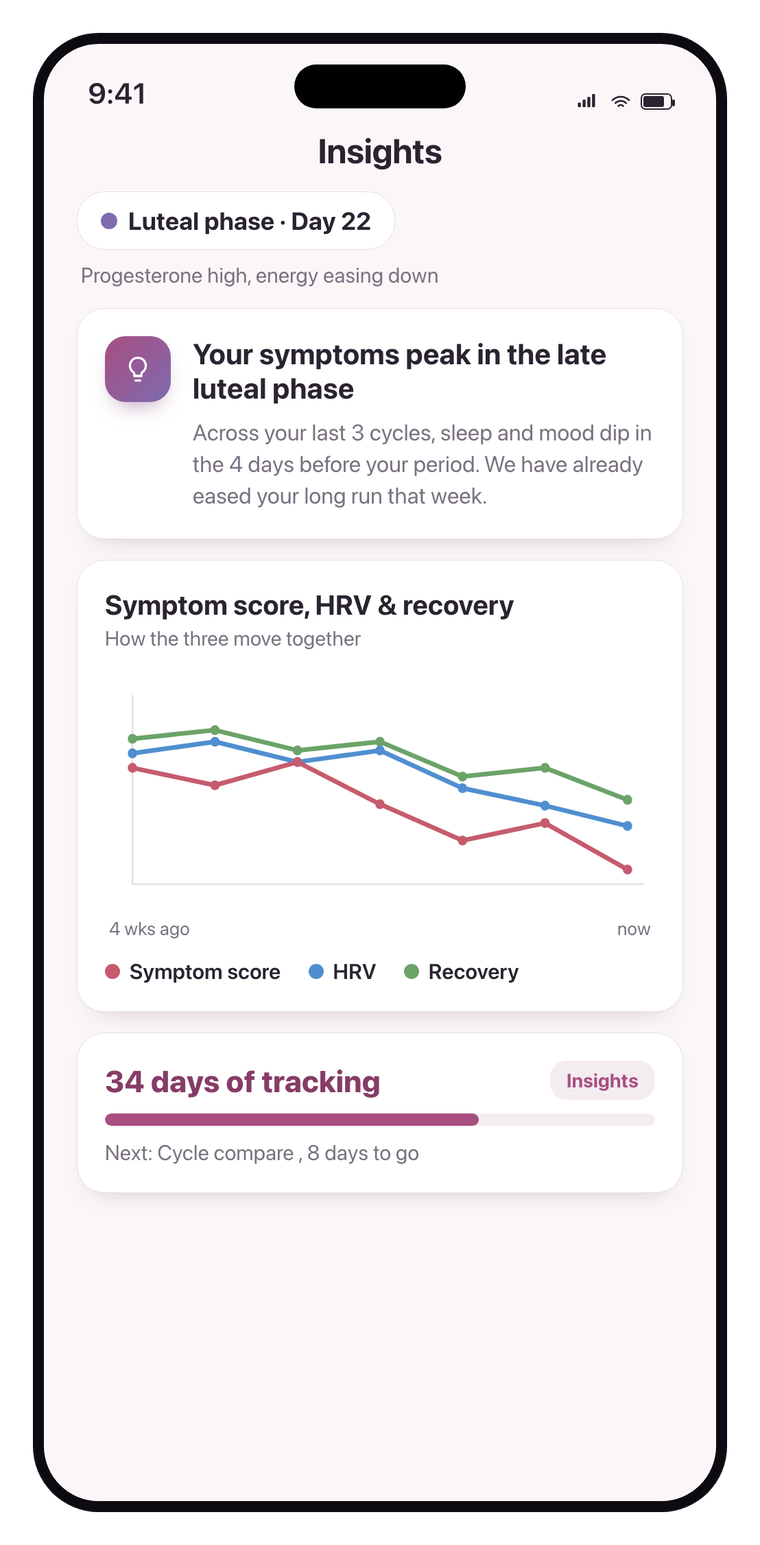
Phaes vs Clue, at a glance
| Phaes | Clue | |
|---|---|---|
| Adaptive plan: race, fitness, or strength | – | |
| Cycle phase as a training input | – | |
| Daily check-in drives training | – | |
| Heavy strength in the same plan | – | |
| Perimenopause tracking | ||
| Free cycle and symptom tracking | ||
| Deep analytics for irregular cycles | Basic |
Clue is a tracker. Phaes is a coach.
Clue earned its reputation on rigor: clean cycle data, a science-backed approach, and a perimenopause mode that copes well with cycles that lengthen and wander. If your goal is to understand and chart your cycle, Clue is hard to beat, and Phaes does not try to out-chart it.
Phaes uses that cycle information for a different purpose: deciding what you should train. It is a women-specific running and strength coach where your cycle phase and daily recovery shape the plan, not just a graph you look back on. The way it trains you reflects real coaching practice for women, not a one-size template with cycle labels on it.
What that looks like in practice
Training that adapts to your cycle and how you feel
A quick daily check-in feeds your plan, so hard work lands in windows where you recover well and eases off when it would cost you. Whether your cycles are regular or wandering through perimenopause, the coaching adapts. See cycle-based training.
Strength built in, not bolted on
Heavy strength sits in the same plan as your runs, with day-level locking so neither gets dropped. Through perimenopause and menopause, that is how you protect bone and muscle while you keep running.
Does Clue track bone health in perimenopause?
Not as a dedicated feature, as far as Clue publishes. Clue Perimenopause, part of Clue Plus, adds perimenopause-specific tracking (hot flashes, night sweats, brain fog, MHT (HRT)) and a view for comparing cycles. Bone health is covered in Clue's articles rather than tracked. Protecting bone in this stage is mostly about training: progressive heavy strength and impact work. See plyometrics for bone density and how often women over 40 should lift.
Does Clue include workouts?
No. Clue tells you which phase you are in, but it does not build a workout plan or change your training because of it. We cover that gap in more detail in does Clue have workouts?
A common setup: Clue for the cleanest view of your cycle, Phaes for the training that responds to it.
Frequently asked questions
Is Phaes a replacement for Clue?
For pure cycle tracking and deep analytics on irregular cycles, Clue is excellent and Phaes is not trying to replace that. Phaes is a coach: it turns your cycle and recovery into an adaptive running and strength plan. Plenty of women use both.
Does Phaes handle irregular or perimenopausal cycles?
Yes. The plan is driven first by a daily check-in, so even when cycles are irregular or have stopped, the coaching still adapts. Cycle phase layers on when it applies.
Does Clue Perimenopause track bone health?
Not as a dedicated feature, as far as Clue publishes. Clue Perimenopause focuses on cycle and symptom tracking, including hot flashes, night sweats, and MHT (HRT), with bone health covered in its articles. Protecting bone in perimenopause mostly comes down to progressive heavy strength and impact work, which Phaes programs into an adaptive plan.
Is cycle tracking free in Phaes?
Yes. Cycle tracking, symptom logging, MHT (HRT) tracking, and body composition are free. Phaes Insights, your daily read and trends, is $3.99 per month or $29.99 per year, and Phaes Coach, the adaptive plan and a coach that adjusts it, is $9.99 per month or $69.99 per year, with a free first week.