Phaes vs the AI running coaches, at a glance
| Phaes | Runna | The Running Genie | TrainAsONE | Garmin Coach | |
|---|---|---|---|---|---|
| Built specifically for women | – | – | – | – | |
| Cycle and symptoms as a plan input | Guidance | – | – | – | |
| Perimenopause and menopause support | – | – | – | – | |
| Daily subjective check-in drives the plan | – | HRV, sleep | Post-run feel | Readiness | |
| Heavy strength for bone and muscle | Light | – | – | ||
| Adaptive weekly plans | |||||
| Device and Strava sync | Strava, Apple Health | Native | |||
| 5K to marathon plans |
The running coaches caught up. They still are not built for you.
Five years ago, "adaptive AI coaching" was a real differentiator. It is not anymore. Runna, The Running Genie, TrainAsONE, and even free Garmin Coach plans now adjust to last week's runs, read your watch, and spit out a credible 5K to marathon block in seconds. On those axes they are good, and we are not going to pretend otherwise.
What every one of them shares is a blind spot: they coach a generic body. The same tempo run feels easy one week and brutal ten days later, and a plan that only watches pace and heart rate treats both days the same. Phaes is built from the ground up around the single biggest variable in how a woman recovers and adapts, her hormones. It encodes the methods real coaches use to train women through their cycle, perimenopause, and menopause, not a generic block with cycle tips bolted on.
What to look for in a running coach as a woman
Most "best running app" lists score every app on the same checklist: adaptivity, device sync, race distances, price. Those matter, and the table above shows the field is close on all of them. The questions that actually separate a coach built for you are different:
- Does your menstrual cycle change the plan, or just show up as a note?
- Are perimenopause and menopause designed-for seasons, or unsupported edge cases?
- Does a daily check-in for sleep, energy, soreness, and symptoms drive the work, or does the plan only watch your watch?
- Is heavy strength programmed in the same plan for bone and muscle, or bolted on as mobility and pilates?
Phaes is the only coach in the table that answers yes to all four.
Cycle and symptoms are a first-class input, not guidance
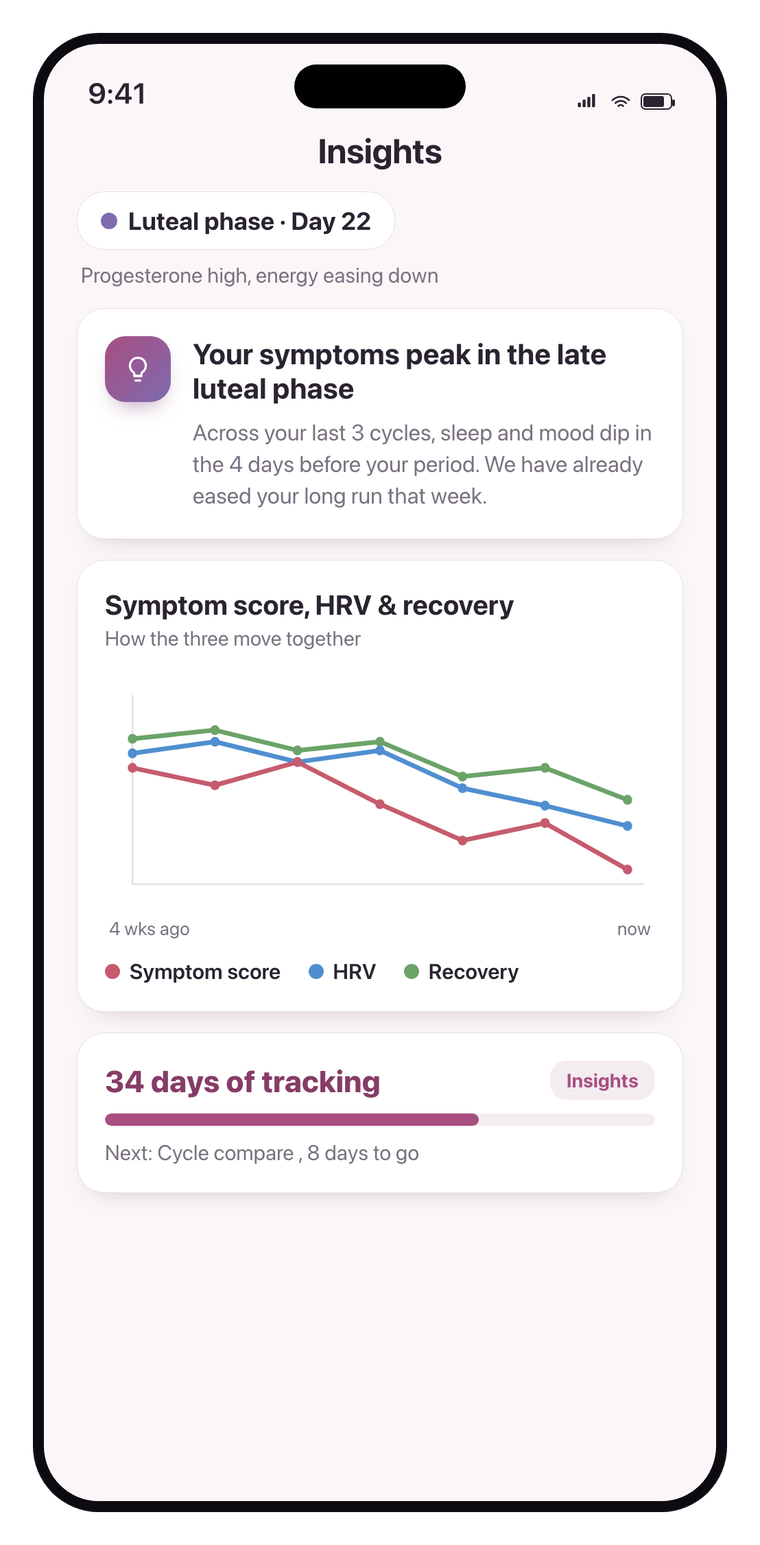
Runna deserves credit here: it added cycle education and phase-based suggestions. But guidance is a tip you read, not a plan that changes. In Phaes, where you are in your cycle and how you logged your symptoms feed straight into what you are asked to do today. Hard work lands in windows where you recover well, and the plan eases off when the same load would cost you more.
Strength that protects bone and muscle
Runna's strength is mobility and conditioning, TrainAsONE has none, and Garmin's is solid but not built around your hormones. Phaes programs heavy resistance work in the same plan as your runs, with day-level locking so neither gets dropped. That matters more every year, especially through perimenopause and menopause, when protecting bone and muscle is as important as the mileage.
Which one is right for you
- TrainAsONE if you want the most aggressive pure-running ML and you do not need strength.
- The Running Genie if you live in Strava and want a sharp, methodology-forward AI coach.
- Garmin Coach if you have a Garmin and want capable adaptive plans for free.
- Runna if you want a polished general-purpose coach with light strength and cycle tips.
- Phaes if you want a coach that is women-specific from the engine up: your cycle, your symptoms, perimenopause and menopause, and heavy strength, all in one adaptive plan.
We sync with Strava and Apple Health today, with more integrations coming. See how a running coach for women is different, or read the head-to-head on Phaes vs Runna.
Frequently asked questions
Are the other AI running coaches bad?
No. Runna, The Running Genie, TrainAsONE, and Garmin Coach are genuinely good at adaptive plans and device sync, and the comparison table reflects that honestly. The difference is that they coach a generic body. Phaes is the only one built around your cycle, perimenopause, and menopause as real training inputs.
Does Phaes work with Strava and my watch?
Yes. Phaes connects to Strava and to Apple Health today, so your runs and recovery data flow in automatically. More integrations are on the way.
Runna says it supports the menstrual cycle now. How is Phaes different?
Runna offers cycle education and phase-based suggestions, which is useful, but it is guidance you read, not a plan that changes. In Phaes, your cycle phase and daily symptom check-in feed directly into the workout you are prescribed that day.
How much does Phaes cost?
The app is free to download, and cycle tracking, symptom logging, MHT (HRT) tracking, and body composition tracking are free. Phaes Insights, which adds your daily read and your trends, is $3.99 per month or $29.99 per year. Phaes Coach adds the adaptive training plan and a coach that adjusts it week to week at $9.99 per month or $69.99 per year, with a free first week.