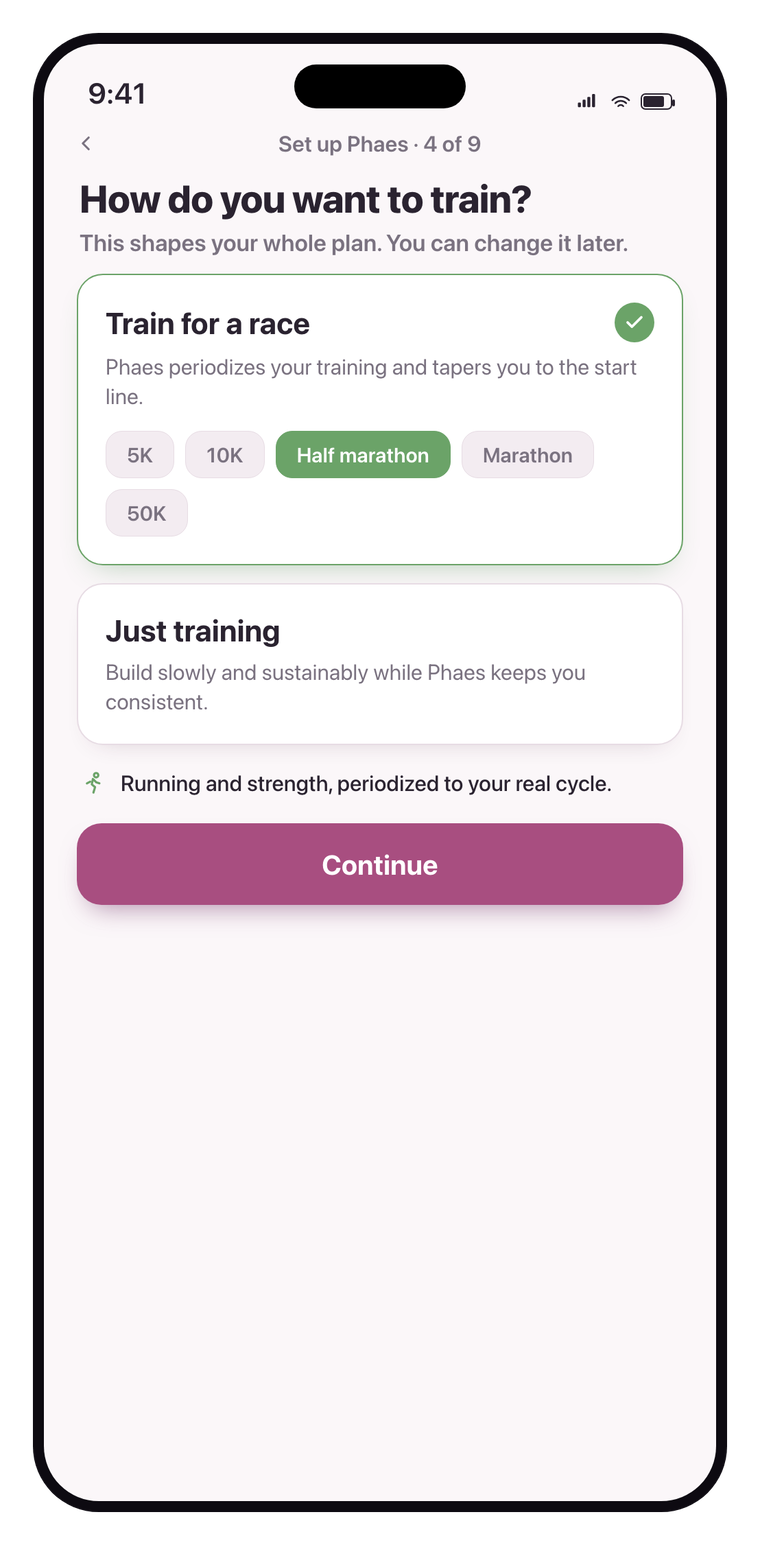
The real challenge: a fixed date, a moving body
A half marathon build is a fixed progression toward a fixed day. Perimenopause is the opposite: cycles that shorten, lengthen, or skip, sleep that frays without warning, and energy that swings week to week. The friction between a rigid plan and an unpredictable body is exactly why so many women feel like they are failing a plan that never accounted for them. For why this happens, see why running feels harder during perimenopause.
How Phaes builds a half through the volatility
The plan flexes, the race date does not
Phaes still builds a real progression toward your date, with a long run that grows and quality work that sharpens you. The difference is that a rough, low-sleep, symptom-heavy week reshapes the days around it instead of forcing a key session you cannot execute. Hard work gets repositioned, not deleted, so you keep arriving at the start line trained.
Driven by your check-in, not a calendar
Because perimenopause cycles wander, a textbook 28-day periodization is wrong most months. Phaes works from your daily check-in (sleep, energy, soreness, symptoms) and your real cycle, so the plan tracks the body you have this week.
Strength stays in the build
Heavy strength does not get dropped when mileage climbs. It protects bone and muscle as estrogen swings and keeps you durable through the repetitive load of half marathon training, with day-level locking so it actually happens.
Recovery as the limiter
A load guard keeps the build conservative, and the plan spaces hard work around how you actually recover. The same recovery-first thinking carries through to the other side, once cycles stop (below).
Half marathon training for women over 40
The half marathon is a fantastic distance over 40: long enough to be a real challenge, short enough to recover from well. The build is the same ingredients as always (a long run, some quality work, easy mileage, and strength) but the proportions shift. Recovery matters more, strength is non-negotiable, and the plan has to flex around a cycle that may be changing. For what a week can look like, see the sample intermediate half marathon week for women over 40.
Half marathon training during menopause
After menopause, the half marathon hits a sweet spot. The training load is meaningful but recoverable, which matters when estrogen has dropped and recovery takes longer. You get a real goal without the relentless mileage of a marathon build, leaving room to keep heavy strength central. Phaes builds the same race-date progression, driven by your check-in rather than a cycle, on top of the menopause running plan. Ready for more? See marathon training during menopause.
Where it fits
This is the half-specific build for the perimenopause years, layered on the adaptive coaching in running through perimenopause. For the broader picture of training in this decade, see running over 40.
Frequently asked questions
Can I train for a half marathon while my cycle is unpredictable?
Yes. The key is a plan that adapts to how you feel rather than a fixed calendar, so a rough or symptom-heavy week reshapes the days around it instead of forcing key sessions. Phaes builds a real progression toward your race date and flexes the week around your daily check-in.
How is this different from a normal half marathon plan?
A normal plan assumes a predictable body. During perimenopause, sleep, energy, and cycle length swing, so Phaes repositions hard work rather than deleting it, keeps heavy strength in throughout, and uses a load guard to stay conservative through the build.
How long does it take to train for a half marathon over 40?
Most runners build over roughly 10 to 16 weeks depending on starting fitness. Phaes sets the progression from your race date and current volume, and adapts it week to week based on your check-ins rather than forcing a fixed calendar.
How long does it take to train for a half marathon during menopause?
Often around 10 to 16 weeks depending on starting fitness, with more built-in recovery than a younger runner might need. Phaes sets the progression from your race date and current volume and adapts it week to week based on your check-ins.
Should I keep lifting while training for a half marathon?
Yes. Phaes keeps heavy strength in the plan through the build to protect bone and muscle and keep you durable, with day-level locking and a load guard so strength and running do not stack into injury.
Keep reading
- Running through perimenopause
- Sample half marathon week for women over 40
- When to start training for a spring race